How to Calm Anxious Attachment Thoughts: A 10-Minute Reset
Anxious AttachmentRelationship AnxietySelf-Soothing
Quick answer
How do I calm my anxious attachment thoughts fast?
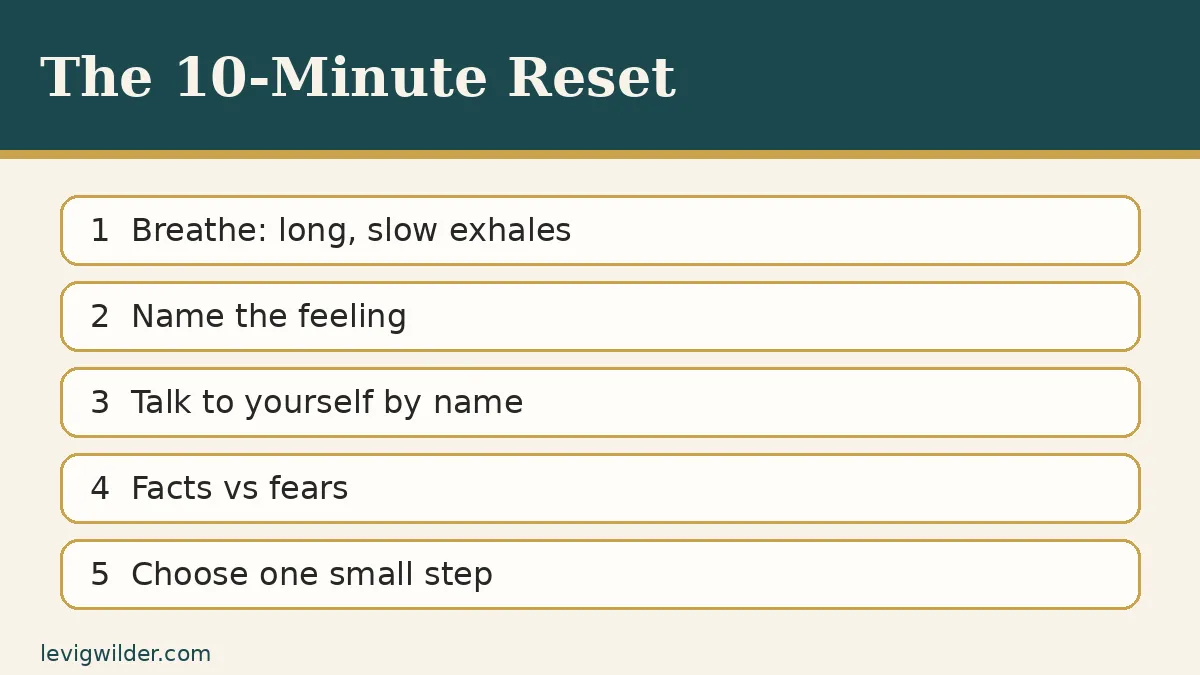
To calm anxious attachment thoughts, first settle your body with slow breathing and a longer exhale. Then name the feeling in a few words, talk to yourself by name, and separate facts from fears. Finally, choose one small action: wait, do something kind for yourself, or send one clear, calm message.
By Levi G. Wilder. I'm a researcher and trauma survivor, not a therapist. This is education and self-help, not therapy. If anxiety is overwhelming you or you're thinking about harming yourself, contact your local emergency number or a crisis line.
You know the moment. A message goes unanswered, a plan changes, a partner sounds a little flat on the phone, and suddenly your mind is three steps into a breakup that hasn't happened. You know it might be nothing. It doesn't feel like nothing.
This guide gives you a 10-minute reset for those moments. It doesn't ask you to stop caring or to "just relax". It works with the way the attachment system actually behaves, using techniques that have research behind them.
Why do anxious attachment thoughts take over so fast?
Attachment researchers describe adult attachment along two dimensions, anxiety and avoidance (Fraley, Waller & Brennan, 2000). If you're high on anxiety, your attachment system is quick to notice possible distance. When it does, it hyperactivates: you become more watchful, more emotional and more driven to restore contact (Mikulincer & Shaver, 2003).
That strategy often made sense in childhood. If a caregiver was sometimes available and sometimes not, turning up the signal raised the odds of being noticed. As an adult, though, the same alarm fires at a slow text. And once your body is in alarm mode, your thinking narrows. You look for evidence that something is wrong, and you usually find some.
That's why the reset starts with the body, not with arguing against the thoughts. You can't reason well from inside an alarm.
What is the 10-minute reset?
Five steps, about two minutes each. You can do the short version in less time, but the full ten minutes gives your body a real chance to settle.
Step 1 (minutes 0–2): How do you slow your body down?
Breathe in through your nose for about four counts, then out slowly for about six to eight. Let the exhale be longer than the inhale. Keep going for a couple of minutes.
Slow breathing practices have been linked to changes in heart rate variability and in emotional wellbeing (Zaccaro et al., 2018). In a randomised study, five minutes a day of "cyclic sighing", which stresses long exhales, improved positive mood more than mindfulness meditation over a month (Balban et al., 2023). You don't need a perfect technique. Long, slow exhales are the point.
Step 2 (minutes 2–4): Can you name what you feel?
Put the feeling into a word or two: "scared", "lonely", "rejected", "ashamed". Say it quietly or write it down.
This sounds too simple to work, but naming feelings is a well-studied form of emotion regulation. In brain imaging studies, putting feelings into words reduced activity in the amygdala, a region involved in threat responses (Lieberman et al., 2007). Researchers call this affect labelling, and it seems to work even when people don't expect it to (Torre & Lieberman, 2018).
If you grew up in a home where feelings weren't talked about, this step may be hard. That's normal. "Bad" or "tight in my chest" counts.
Step 3 (minutes 4–6): What happens if you talk to yourself by name?
Now speak to yourself as if you were a kind friend, using your own name or "you": "Sam, you're scared they're pulling away. That makes sense. You've felt this before and it passed."
In a series of studies, people who used their own name or "you" in self-talk handled stressful tasks with less distress than people who used "I" (Kross et al., 2014). The small shift in language creates distance, so you can see the situation more like an outsider would.
Step 4 (minutes 6–8): What are the facts, and what are the fears?
Draw two columns on paper or in your notes app.
- Facts: only what you could prove to a stranger. "I sent a message at 6 p.m. It's 9 p.m. No reply yet. They mentioned a work dinner tonight."
- Fears: the story your alarm is telling. "They're bored of me. They're with someone else. I said something wrong."
Then ask one question: "What's another explanation that fits the facts just as well?" You aren't trying to prove the fear wrong. You're widening the view, which is a core idea in cognitive behavioural therapy, an approach with strong evidence for anxiety problems (Hofmann et al., 2012).
Step 5 (minutes 8–10): What is one small next step?
Choose one, and only one:
- Wait. Set a time, say an hour, before you check your phone again. Do something absorbing in between.
- Care for yourself. A walk, a shower, a call with a friend, a cup of tea.
- Send one clear message. If you still want to reach out, send one calm, direct message about what you need: "Missing you tonight. Can we talk tomorrow?" Not a test, not a hint, not five messages.
Planning your response in advance makes it more likely you'll follow through. Research on "if–then" plans, called implementation intentions, shows they help people act on their goals (Gollwitzer & Sheeran, 2006). Try writing one now: "If I notice I'm spiralling about a slow reply, then I'll do the 10-minute reset before I text."
What should you avoid while you're anxious?
- Repeated reassurance-seeking. Asking "Are we OK?" again and again gives brief relief, then the worry returns. Excessive reassurance-seeking is linked with attachment anxiety and relationship problems (Shaver, Schachner & Mikulincer, 2005).
- Checking. Looking at their "last seen", their followers or their location feeds the alarm with more material.
- Protest behaviour. Going silent to make them chase you, or sending a pointed message, usually creates the distance you fear.
- Big decisions. Don't end things, or demand a serious talk, from inside a spike. Wait until you're calmer.
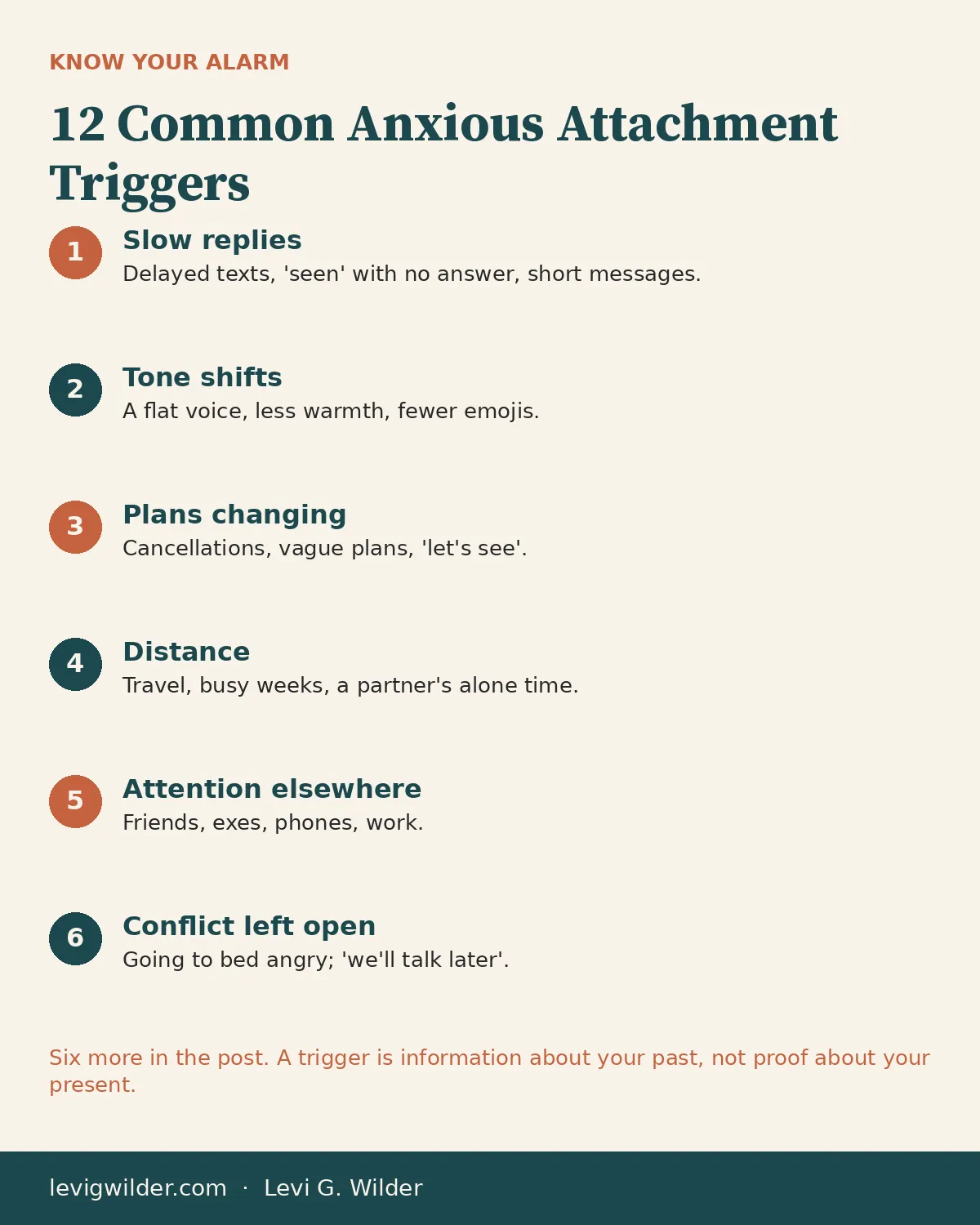
If a particular situation sets you off every time, our list of 12 anxious attachment triggers may help you spot it early.
What if the reset doesn't work?
Sometimes the alarm stays loud. That doesn't mean you failed. A few things to try:
- Do step 1 again, for longer. Arousal can take 20 minutes or more to come down.
- Move your body: a brisk walk, stairs, shaking out your arms.
- Reach out to someone other than your partner. A friend can be a safe base too.
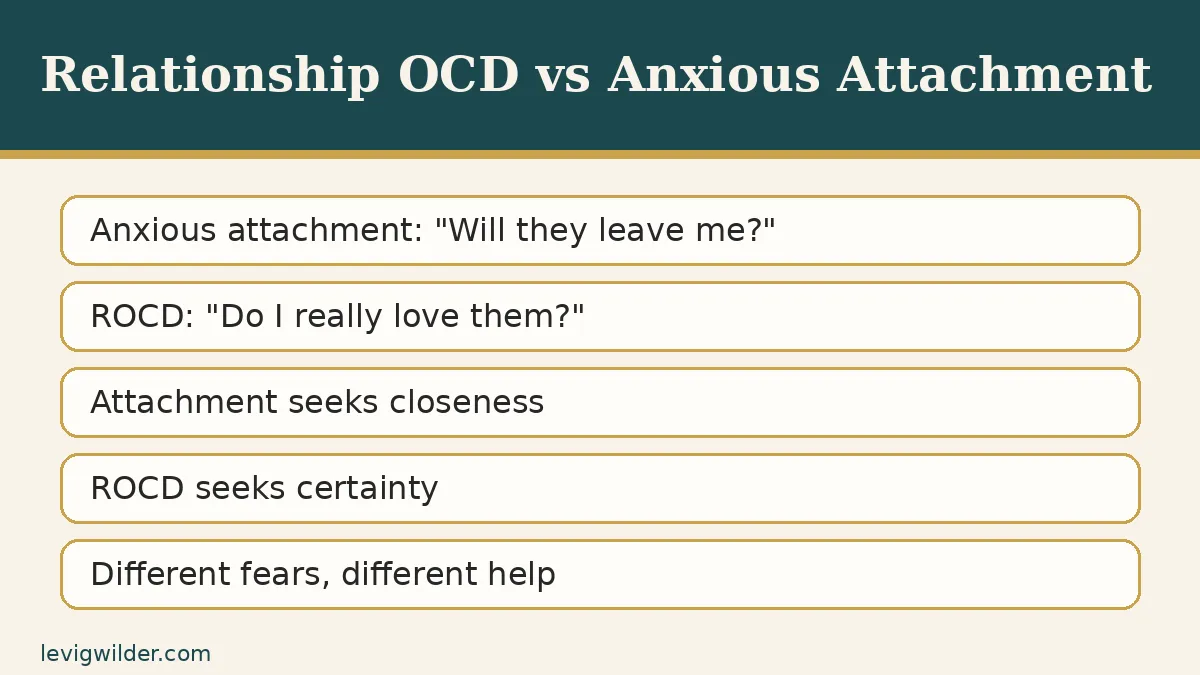
- Notice if the same fear keeps coming back, no matter what your partner does. If doubts feel intrusive and you feel driven to check your own feelings, read relationship OCD vs anxious attachment.
Does practising this actually change anything long term?
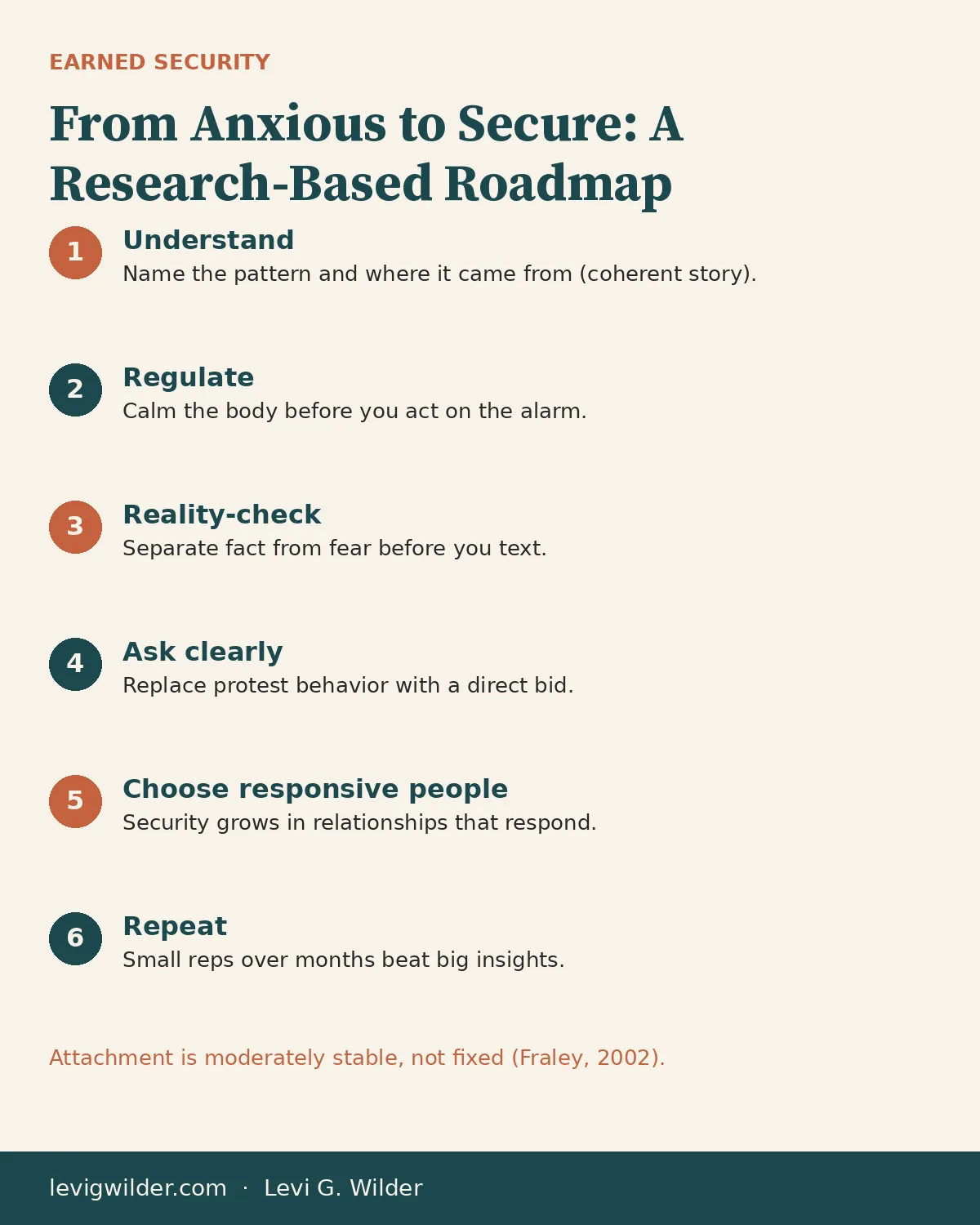
Each time you calm the alarm without acting on it, you give your nervous system a different experience: the fear came, and you were OK. Over time, experiences of safety, especially with reliable people, can shift attachment toward security (Arriaga et al., 2018). Studies that repeatedly remind people of secure relationships ("security priming") have found small but real benefits for mood and behaviour (Gillath et al., 2022).
Change is gradual. Expect weeks and months of practice, not a single breakthrough. For more on that, see can anxious attachment be cured?
Where can you go from here?
If you'd like a fuller plan, I wrote Loved but Never Seen, a printable anxious attachment workbook for adults who grew up emotionally neglected. It includes a 30-day practice built around these skills. You can also get it in the bundle with The Emotional Neglect Workbook. Everything is on the books page.
FAQ
How do I calm my anxious attachment thoughts fast?
Start with your body: a few minutes of slow breathing with a longer exhale. Then name the feeling in a word or two, separate facts from fears, and delay any reaction until you feel calmer.
Why do anxious attachment thoughts spiral?
When the attachment system senses distance, it turns up vigilance and emotion to restore closeness. The mind then searches for threats and finds them, which keeps the loop going.
Should I text my partner when I'm anxious?
Wait until your body has calmed a little. Then, if you still want to, send one clear, kind message about what you need rather than several messages trying to get a reaction.
Can anxious attachment thoughts go away completely?
They usually become less frequent and easier to handle with practice and responsive relationships. Most people still have anxious moments; the difference is that the moments pass faster.
Sources
- Arriaga, X. B., Kumashiro, M., Simpson, J. A., & Overall, N. C. (2018). Revising working models across time: Relationship situations that enhance attachment security. Personality and Social Psychology Review, 22, 71–96. https://doi.org/10.1177/1088868317705257
- Balban, M. Y., et al. (2023). Brief structured respiration practices enhance mood and reduce physiological arousal. Cell Reports Medicine, 4, 100895. https://doi.org/10.1016/j.xcrm.2022.100895
- Fraley, R. C., Waller, N. G., & Brennan, K. A. (2000). An item response theory analysis of self-report measures of adult attachment. Journal of Personality and Social Psychology, 78, 350–365. https://doi.org/10.1037/0022-3514.78.2.350
- Gillath, O., et al. (2022). Attachment security priming: A meta-analysis. Personality and Social Psychology Review, 26, 183–241. https://doi.org/10.1177/10888683211054592
- Gollwitzer, P. M., & Sheeran, P. (2006). Implementation intentions and goal achievement: A meta-analysis. Advances in Experimental Social Psychology, 38, 69–119. https://doi.org/10.1016/S0065-2601(06)38002-1
- Hofmann, S. G., Asnaani, A., Vonk, I. J. J., Sawyer, A. T., & Fang, A. (2012). The efficacy of cognitive behavioral therapy: A review of meta-analyses. Cognitive Therapy and Research, 36, 427–440. https://doi.org/10.1007/s10608-012-9476-1
- Kross, E., et al. (2014). Self-talk as a regulatory mechanism: How you do it matters. Journal of Personality and Social Psychology, 106, 304–324. https://doi.org/10.1037/a0035173
- Lieberman, M. D., et al. (2007). Putting feelings into words. Psychological Science, 18, 421–428. https://doi.org/10.1111/j.1467-9280.2007.01916.x
- Mikulincer, M., & Shaver, P. R. (2003). The attachment behavioral system in adulthood. Advances in Experimental Social Psychology, 35, 53–152. https://doi.org/10.1016/S0065-2601(03)01002-5
- Shaver, P. R., Schachner, D. A., & Mikulincer, M. (2005). Attachment style, excessive reassurance seeking, relationship processes, and depression. Personality and Social Psychology Bulletin, 31, 343–359. https://doi.org/10.1177/0146167204271709
- Torre, J. B., & Lieberman, M. D. (2018). Putting feelings into words: Affect labeling as implicit emotion regulation. Emotion Review, 10, 116–124. https://doi.org/10.1177/1754073917742706
- Zaccaro, A., et al. (2018). How breath-control can change your life: A systematic review on psycho-physiological correlates of slow breathing. Frontiers in Human Neuroscience, 12, 353. https://doi.org/10.3389/fnhum.2018.00353