Can Anxious Attachment Be Cured? What Research Says About Becoming Secure
Anxious AttachmentEarned SecurityHealing
Quick answer
Can anxious attachment be cured?
Anxious attachment is not an illness, so "cured" is the wrong word, but it can change. Research shows attachment is only moderately stable, and many adults develop "earned security" through therapy, emotional-regulation skills and responsive relationships. Change is usually gradual, built through repeated experiences of safety over months or years, not one breakthrough.
By Levi G. Wilder. I'm a researcher and survivor, not a therapist. This is education, not therapy.
"Can anxious attachment be cured?" is one of the most searched questions about attachment, and I understand why. When you've spent years checking phones and replaying conversations, you want to know whether there's an end to it, or whether this is simply who you are.
Here's the honest answer, based on the research rather than on promises: "cured" is the wrong word, but change is real. Attachment patterns can shift toward security. It usually happens gradually, through repeated experiences, not one breakthrough. Let me show you what the evidence actually says, and what tends to help.
Why "cure" is the wrong frame
Anxious attachment isn't a disease. It's a learned strategy for staying close to people when closeness felt uncertain. Researchers measure attachment on continuous dimensions, anxiety and avoidance, not as fixed categories (Fraley, Waller & Brennan, 2000). So the realistic goal isn't flipping from "anxious" to "secure" like a switch. It's moving along the anxiety dimension: worrying less often, recovering faster, and acting from choice instead of alarm.
That reframe matters, because people who expect a cure often feel like failures the first time they get triggered after months of progress. A trigger isn't a relapse. It's an old path your brain still knows. The question is how quickly you find the new one.
What research says about attachment change
Attachment is moderately stable, not fixed
A major meta-analysis by R. Chris Fraley looked at how stable attachment security is from infancy into adulthood. The conclusion: attachment shows moderate stability, but there's plenty of room for change (Fraley, 2002). Your early experiences set a starting point. They don't set a destination.
Relationships can revise your "working model"
Attachment theory describes "working models", your deep expectations about whether others will be there and whether you're worth being there for. A review by Arriaga and colleagues outlines how relationship experiences can revise those models over time, especially when a partner responds in ways that disconfirm old fears (Arriaga et al., 2018). In plain terms: repeated experiences of being responded to can slowly teach your nervous system a new rule.
"Earned security" exists, with nuance
Researchers use the term "earned security" for adults who describe difficult early relationships but now show a secure, coherent way of thinking about attachment. A long-term study by Roisman and colleagues found that this group is real, but also that the picture is more complicated than popular articles suggest (Roisman et al., 2002). I mention that because I don't want to sell you a fairy tale. Security can be built. It's not a quick fix, and it looks different for everyone.
Feeling secure can be practiced
Studies on "security priming" have participants recall or imagine supportive people. A 2022 meta-analysis found these brief reminders of supportive relationships reliably boosted feelings of security and related outcomes in the short term (Gillath et al., 2022). Short-term effects aren't a cure, but they suggest something important: your mind can access security, and repeated practice may strengthen that path.

Six steps toward secure attachment
1. Understand your story
Securely attached adults tend to tell coherent stories about their childhood, including the painful parts. Write yours down: what was it like to need comfort as a child? Who responded, and how? If your caregivers were physically present but emotionally hard to reach, you may be dealing with emotional neglect underneath the anxiety. I wrote about that link in signs of anxious attachment in adults.
2. Regulate before you respond
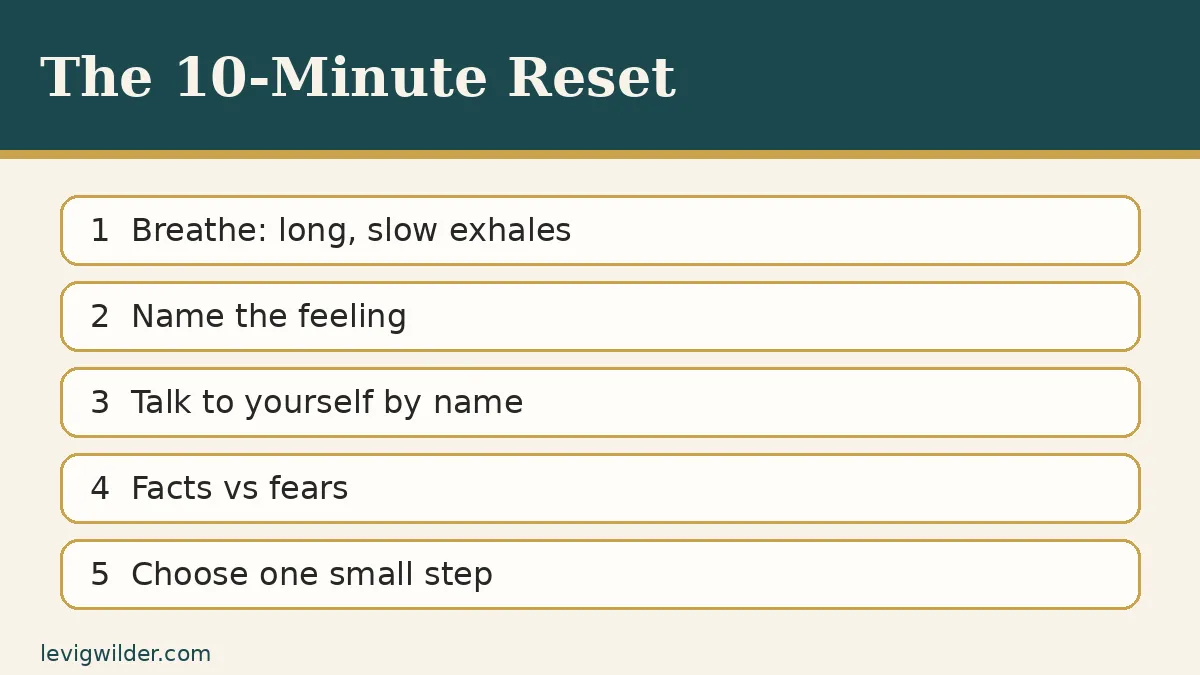
You can't think clearly with your alarm blaring. Slow breathing with long exhales has research support for calming the body and improving mood (Balban et al., 2023; Zaccaro et al., 2018). Make it a five-minute daily habit, not just an emergency tool.
3. Reality-check the fear
When triggered, separate facts ("they haven't replied for two hours") from fears ("they're pulling away"). This one skill prevents a lot of protest behavior. My guide to anxious attachment triggers walks through it.
4. Ask clearly instead of protesting
Protest behavior, such as testing, sulking or flooding someone with messages, tries to get closeness indirectly. Clear asks get it directly: "I'm feeling insecure tonight. Could you tell me something you like about us?" Asking for reassurance isn't the problem. Research links excessive, repeated reassurance-seeking with relationship strain (Shaver, Schachner & Mikulincer, 2005), so the aim is to ask clearly and then let the answer land.
5. Choose responsive people
This one is hard but crucial. Security grows in relationships that respond. If you're with someone who consistently withdraws when you reach out, your alarm will keep firing, not because you're broken but because the signal is accurate. That doesn't always mean leaving. Couples therapy, particularly emotionally focused therapy, has strong research support for helping couples break pursue–withdraw cycles (Wiebe & Johnson, 2016; Spengler et al., 2024). But notice who in your life helps you feel steady, and spend more time there.
6. Repeat, in small reps
Change comes from many small moments handled differently, not from insight alone. Research on habit formation found that automatic habits took a median of about 66 days to form, with a wide range between people (Lally et al., 2010). If-then plans can help you follow through when it counts (Gollwitzer & Sheeran, 2006). For example: "If I feel the urge to check their location, then I'll do five slow breaths and text a friend."
How long does it take?
Honestly, it varies. Many people notice they recover faster from triggers within a few weeks of daily practice. Deeper shifts, like feeling worthy of steady love or choosing secure partners, often take months or longer, and they're helped by therapy and by safe relationships. Be suspicious of anyone promising to "rewire your attachment style" in a set number of days.
Signs you're becoming more secure
- You still get triggered, but you calm down in minutes instead of hours.
- You can wait for a reply without spiraling.
- You ask directly for what you need, and survive the vulnerability.
- Consistent, kind people start to feel attractive rather than boring.
- Your self-worth holds steady even when your partner is in a bad mood.
Where to start today
Pick one step above and practice it for the next week. If you'd like structure, the free Secure Practice Companion gives you printable trackers and a guided calming script. And Loved but Never Seen, my anxious attachment workbook for adults who grew up emotionally neglected, includes a full 30-day practice built on the research in this post. You can get the printable workbook here.
What gets in the way
A few common obstacles slow people down. Knowing them in advance helps:
- Waiting to feel ready. Security usually follows action. You ask clearly while scared, and the feeling catches up later.
- Using insight as a substitute for practice. Reading about attachment is helpful, but your nervous system learns from experience, not explanations.
- All-or-nothing thinking. One anxious evening doesn't erase a month of progress. Track your recovery time, not perfection.
- Doing it all alone. Ironically, many anxiously attached people, especially those who grew up emotionally neglected, try to heal in total self-reliance. Letting a friend, therapist or partner be part of the process is part of the healing itself.
Be patient with yourself here. You learned your current strategy over years, in a relationship you didn't choose. Learning a new one takes repetition, in relationships you do choose.
FAQ
Can anxious attachment be cured?
Not in the sense of an illness being cured, because it's a learned pattern. But research shows attachment can shift toward security over time through practice, therapy and responsive relationships.
Can anxious attachment turn into secure attachment?
Yes, many adults move toward security. Researchers call this "earned security", though how it develops varies from person to person.
Can anxious attachment be fixed without therapy?
Self-help practices and secure relationships can help a lot. Therapy can speed things up and is recommended if anxiety is severe or tied to trauma.
How long does it take to heal anxious attachment?
There's no fixed timeline. Many notice faster recovery from triggers within weeks, while deeper changes often take months of consistent practice.
Sources
- Arriaga, X. B., Kumashiro, M., Simpson, J. A., & Overall, N. C. (2018). Revising working models across time: Relationship situations that enhance attachment security. Personality and Social Psychology Review, 22, 71–96. https://doi.org/10.1177/1088868317705257
- Balban, M. Y., et al. (2023). Cell Reports Medicine, 4, 100895. https://doi.org/10.1016/j.xcrm.2022.100895
- Fraley, R. C. (2002). Attachment stability from infancy to adulthood: Meta-analysis and dynamic modeling of developmental mechanisms. Personality and Social Psychology Review, 6, 123–151. https://doi.org/10.1207/S15327957PSPR0602_03
- Fraley, R. C., Waller, N. G., & Brennan, K. A. (2000). Journal of Personality and Social Psychology, 78, 350–365. https://doi.org/10.1037/0022-3514.78.2.350
- Gillath, O., et al. (2022). Attachment security priming: A meta-analysis. Personality and Social Psychology Review, 26, 183–241. https://doi.org/10.1177/10888683211054592
- Gollwitzer, P. M., & Sheeran, P. (2006). Advances in Experimental Social Psychology, 38, 69–119. https://doi.org/10.1016/S0065-2601(06)38002-1
- Lally, P., et al. (2010). How are habits formed. European Journal of Social Psychology, 40, 998–1009. https://doi.org/10.1002/ejsp.674
- Roisman, G. I., Padrón, E., Sroufe, L. A., & Egeland, B. (2002). Earned-secure attachment status in retrospect and prospect. Child Development, 73, 1204–1219. https://doi.org/10.1111/1467-8624.00467
- Shaver, P. R., Schachner, D. A., & Mikulincer, M. (2005). Personality and Social Psychology Bulletin, 31, 343–359. https://doi.org/10.1177/0146167204271709
- Spengler, P. M., et al. (2024). A comprehensive meta-analysis on the efficacy of emotionally focused couple therapy. Couple and Family Psychology: Research and Practice. https://doi.org/10.1037/cfp0000233
- Wiebe, S. A., & Johnson, S. M. (2016). Family Process, 55, 390–407. https://doi.org/10.1111/famp.12229
- Zaccaro, A., et al. (2018). Frontiers in Human Neuroscience, 12, 353. https://doi.org/10.3389/fnhum.2018.00353