12 Anxious Attachment Triggers in Relationships (and What to Do When You're Triggered)
Anxious AttachmentRelationshipsRelationship Anxiety
Quick answer
What triggers anxious attachment?
Anxious attachment triggers are moments of uncertainty about closeness: slow replies, a change in tone, cancelled plans, emotional distance, unresolved conflict or mixed signals. They activate the attachment system's alarm, causing racing thoughts and urges to seek reassurance. When triggered, pause, name the feeling, calm your body, check the facts, then ask for what you need clearly.
By Levi G. Wilder. I'm a researcher and survivor, not a therapist. This is education, not therapy or diagnosis.
It's 9:47 p.m. You sent a message at 6:12. You can see they've been online. Your chest is tight, your thoughts are racing through every possible reason, and part of you knows you're overreacting while another part is absolutely sure something is wrong.
That's what an anxious attachment trigger feels like from the inside. It isn't a choice and it isn't drama. It's an old alarm system doing exactly what it was built to do. Let's look at the most common triggers, why they hit so hard, and what you can actually do in the moment.
First, what is anxious attachment?
Attachment researchers describe adult attachment along two dimensions: anxiety (fear of rejection and abandonment) and avoidance (discomfort with closeness) (Fraley, Waller & Brennan, 2000). Someone high in attachment anxiety tends to watch closely for signs that a partner is pulling away.
Psychologists Mario Mikulincer and Phillip Shaver call this hyperactivation: when the attachment system senses a possible threat to closeness, it turns up its volume. You get more vigilant, more emotional, and more driven to restore contact (Mikulincer & Shaver, 2003). It's a strategy many people learned as children when caregivers were sometimes available and sometimes not. If you turned up your signal, you had a better chance of being noticed.
In the research and in my own life, this strategy shows up especially often in people who grew up emotionally neglected: loved, but not really seen.

12 common anxious attachment triggers
1. Slow or short replies
The classic. A delay or a one-word answer gets read as loss of interest. Texting gives the brain lots of ambiguity to fill in, and an anxious brain fills it with threat.
2. A change in tone
Flatter voice, fewer emojis, no "x" at the end. Small shifts in warmth are noticed instantly.
3. Cancelled or vague plans
"Let's see how the week goes" can feel like a door quietly closing.
4. Physical distance
Travel, separate holidays, a busy work season. Distance removes the everyday cues that reassure you.
5. Your partner wanting alone time
Healthy for them, terrifying for your nervous system: "Do they need space from me?"
6. Attention going elsewhere
Friends, work, hobbies, phones, and especially exes or attractive strangers.
7. Unresolved conflict
"Let's talk tomorrow" can mean a sleepless night. An open conflict feels like an open threat.
8. Not being asked about your day
For people with emotional neglect in their history, this one stings in a very specific way. It echoes not being asked as a child.
9. Mixed signals early in dating
Uncertainty is built into early dating, and anxious attachment hates uncertainty. Hot-then-cold contact can feel intensely attractive and painful at the same time.
10. Seeing them happy without you
Photos of a fun night out can trigger "they don't need me."
11. Criticism or a joke at your expense
Even mild feedback can feel like the first step toward being left.
12. Things going really well
This one surprises people. Closeness can raise the stakes: "Now I have more to lose." Some people start testing a relationship precisely when it feels good.
Why triggers feel bigger than the situation
A trigger is your past answering a question your present is asking. The question is "Am I safe in this connection?" When your early experience taught you that closeness could disappear without warning, a small cue carries the weight of all those earlier moments.
That's why reassurance often helps for an hour and then wears off. Research on excessive reassurance seeking found that people high in attachment anxiety were more likely to seek reassurance repeatedly, a pattern linked with relationship strain and depressive symptoms (Shaver, Schachner & Mikulincer, 2005). Reassurance isn't wrong. It just can't do the job alone, because the alarm isn't only about today.
What to do when you're triggered: a 4-step plan
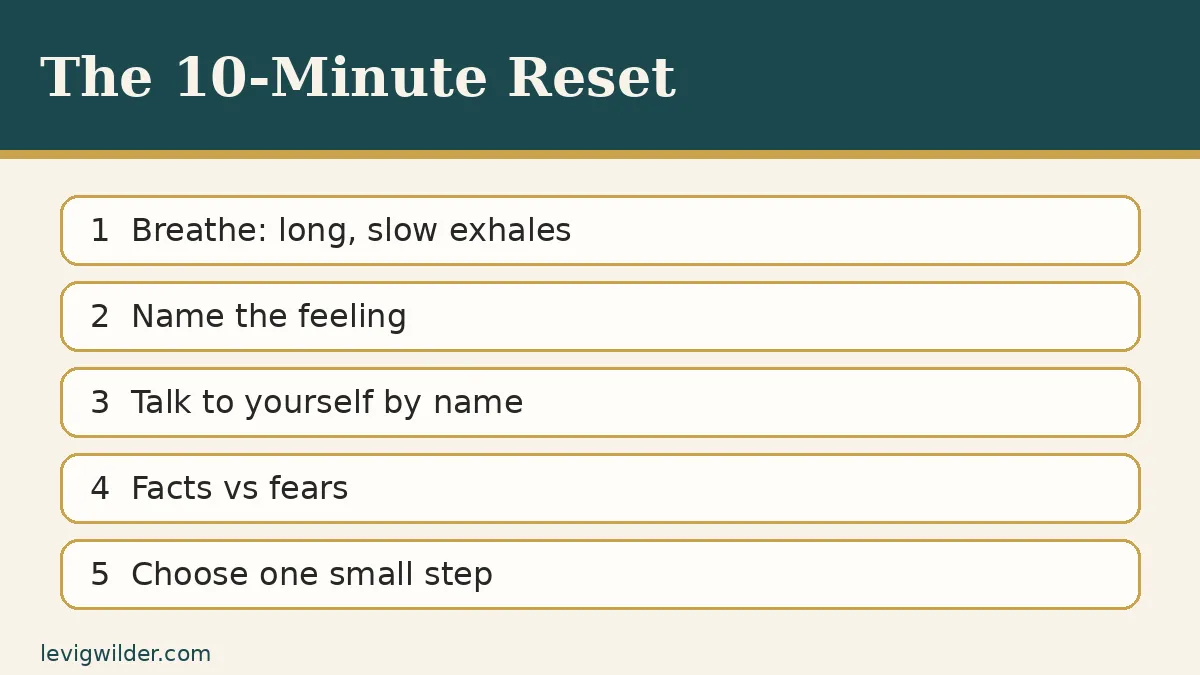
Step 1: Name the alarm
Say it, silently or out loud: "My attachment alarm is going off." Labeling an emotion in words is linked with lower activity in the brain's threat response (Lieberman et al., 2007). It also creates a sliver of distance between you and the panic.
Step 2: Calm the body first
Don't try to think your way out while your heart is racing. Try slow breathing with long exhales for five minutes. In a randomized study, five minutes a day of "cyclic sighing" (two inhales through the nose, one long exhale through the mouth) improved mood and reduced physiological arousal more than mindfulness meditation (Balban et al., 2023). A review of slow-breathing research also links it with calmer physiology and emotional states (Zaccaro et al., 2018).
Step 3: Separate fact from fear
Draw two columns. Facts: "They haven't replied in three hours. They mentioned a deadline today." Fears: "They're losing interest. I said something wrong." Then ask: what would I tell a friend who showed me these columns?
Step 4: Choose a clear bid, or wait
Protest behaviors like double-texting, going silent, or testing someone tend to create the distance you fear. A clear bid sounds like: "Hey, I felt a bit wobbly today. Could we call tonight?" If the urge is to send five messages, try riding it out for 20 minutes first. "Urge surfing", watching an urge rise and fall without acting on it, has some research support in other areas, such as smoking (Bowen & Marlatt, 2009).
Plan ahead with "if-then" rules
Triggers are predictable, so you can prepare. "If-then" plans, also called implementation intentions, have strong research support for helping people follow through on goals (Gollwitzer & Sheeran, 2006). Write two or three:
- If they haven't replied by bedtime, then I'll do five minutes of breathing and put my phone in another room.
- If I feel the urge to check their profile, then I'll text a friend instead.
- If a conflict is left open, then I'll ask for a specific time to talk.
Talking to your partner about triggers
A secure partner usually wants to know what helps. Pick a calm moment, not mid-trigger. Try: "When plans change at the last minute, my anxiety spikes. It's not your fault, it's an old pattern. A quick 'still on for Friday?' text helps a lot." Small, specific agreements beat big promises.
If your partner tends to withdraw when you reach out, you may be caught in an anxious–avoidant cycle. Research has found that this pairing can be stable yet painful (Kirkpatrick & Davis, 1994). Couples therapy, especially emotionally focused therapy, has good research support for this pattern (Wiebe & Johnson, 2016).
A trigger is information, not a verdict
The goal isn't to never be triggered. It's to notice faster, respond more kindly, and act from your adult self instead of your alarm. That's how attachment patterns change: through many small moments handled differently.
If you'd like support with this, I made the free Secure Practice Companion, with printable trigger trackers, a fact-versus-fear sheet and a guided calming script. The full program is in Loved but Never Seen, an anxious attachment workbook for adults who grew up emotionally neglected. You can get the printable workbook here.
Six more triggers people often miss
The list above covers the most common ones, but readers regularly tell me about these too:
- Holidays and anniversaries, when expectations are high and disappointment feels symbolic.
- Your partner being stressed or low, which can feel like withdrawal even when it has nothing to do with you.
- Being left out of plans, even small ones, among friends or family.
- Your own bad days: tiredness, hunger, illness and hormones all lower the threshold for the alarm.
- Endings in other people's lives, such as a friend's breakup, which reminds you that relationships can end.
- Silence after you share something vulnerable, which can feel like rejection of the most exposed part of you.
Make your own list. Over a couple of weeks, note each time the alarm fires: what happened, what you felt in your body, what you feared, and what you did. Patterns appear quickly. Most people find that three or four triggers account for most of their distress, and those are the ones worth planning for first.
FAQ
What triggers anxious attachment?
Common triggers include slow replies, changes in tone, cancelled plans, distance, unresolved conflict and mixed signals. Anything that creates uncertainty about closeness can activate the attachment system.
What should I do when my anxious attachment is triggered?
Name the feeling, calm your body with slow breathing, separate facts from fears, and then make a clear request or wait before acting on urges.
Can anxious attachment triggers go away?
They often become less intense and easier to manage with practice and secure relationships. Attachment patterns are moderately stable but can change over time.
Should I tell my partner about my triggers?
Usually yes, in a calm moment, with a specific request. Explaining the pattern without blaming them helps a partner respond in ways that actually help.
Sources
- Balban, M. Y., et al. (2023). Brief structured respiration practices enhance mood and reduce physiological arousal. Cell Reports Medicine, 4, 100895. https://doi.org/10.1016/j.xcrm.2022.100895
- Bowen, S., & Marlatt, A. (2009). Surfing the urge: Brief mindfulness-based intervention for college student smokers. Psychology of Addictive Behaviors, 23, 666–671. https://doi.org/10.1037/a0017127
- Fraley, R. C., Waller, N. G., & Brennan, K. A. (2000). An item response theory analysis of self-report measures of adult attachment. Journal of Personality and Social Psychology, 78, 350–365. https://doi.org/10.1037/0022-3514.78.2.350
- Gollwitzer, P. M., & Sheeran, P. (2006). Implementation intentions and goal achievement: A meta-analysis. Advances in Experimental Social Psychology, 38, 69–119. https://doi.org/10.1016/S0065-2601(06)38002-1
- Kirkpatrick, L. A., & Davis, K. E. (1994). Attachment style, gender, and relationship stability: A longitudinal analysis. Journal of Personality and Social Psychology, 66, 502–512. https://doi.org/10.1037/0022-3514.66.3.502
- Lieberman, M. D., et al. (2007). Putting feelings into words. Psychological Science, 18, 421–428. https://doi.org/10.1111/j.1467-9280.2007.01916.x
- Mikulincer, M., & Shaver, P. R. (2003). The attachment behavioral system in adulthood. Advances in Experimental Social Psychology, 35, 53–152. https://doi.org/10.1016/S0065-2601(03)01002-5
- Shaver, P. R., Schachner, D. A., & Mikulincer, M. (2005). Attachment style, excessive reassurance seeking, relationship processes, and depression. Personality and Social Psychology Bulletin, 31, 343–359. https://doi.org/10.1177/0146167204271709
- Wiebe, S. A., & Johnson, S. M. (2016). A review of the research in emotionally focused therapy for couples. Family Process, 55, 390–407. https://doi.org/10.1111/famp.12229
- Zaccaro, A., et al. (2018). How breath-control can change your life. Frontiers in Human Neuroscience, 12, 353. https://doi.org/10.3389/fnhum.2018.00353
Related reading: Signs of anxious attachment in adults · Can anxious attachment be cured?