Relationship OCD vs Anxious Attachment: How to Tell the Difference
OCDAnxious AttachmentRelationship Anxiety
Quick answer
What is the difference between ROCD and anxious attachment?
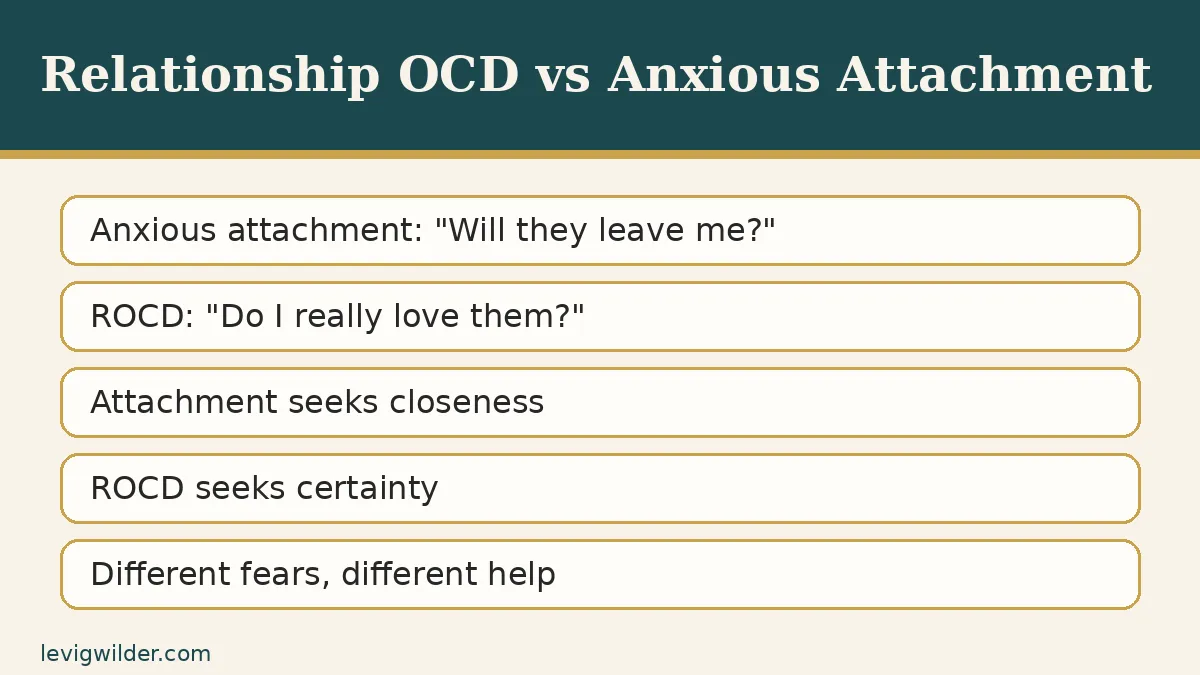
Anxious attachment centres on the fear that your partner will stop loving or leave you. Relationship OCD (ROCD) centres on intrusive doubts about whether you love them, whether they're right for you, or their flaws, with compulsive checking to get certainty. They can overlap, and they respond to different kinds of help.
By Levi G. Wilder. I'm a researcher and trauma survivor, not a therapist. This comparison is for understanding, not diagnosis. Only a qualified clinician can assess OCD.
"Do I really love them?" "Will they leave me?" Both questions can keep you awake at night, and both can make a good relationship feel like a test you're always about to fail. But they come from different places, and the help that works for one can make the other worse.
This guide explains the difference between relationship OCD (often shortened to ROCD) and anxious attachment, where they overlap, and what tends to help each one.
What is anxious attachment?
Attachment researchers describe adult attachment along two dimensions: anxiety and avoidance (Fraley, Waller & Brennan, 2000). People high in attachment anxiety worry about rejection and abandonment. They watch closely for signs that a partner is pulling away, and when they sense distance, the attachment system turns up its volume. Mikulincer and Shaver call this hyperactivation: more vigilance, stronger emotion and a stronger push to restore closeness (Mikulincer & Shaver, 2003).
The core fear is about the other person's love: "They'll stop caring. They'll find someone better. I'm too much."
If that sounds like you, the 15 signs of anxious attachment in adults goes deeper.
What is relationship OCD?
ROCD isn't a separate diagnosis. It's a name researchers and clinicians use for obsessive-compulsive symptoms that focus on a romantic relationship. Psychologist Guy Doron and colleagues describe two main forms (Doron, Derby & Szepsenwol, 2014):
- Relationship-centred: intrusive doubts about your own feelings ("Do I love them enough?"), their feelings, or whether this is the "right" relationship.
- Partner-focused: preoccupation with a partner's perceived flaws, such as their looks, intelligence, social skills or morals.
Like other OCD, these thoughts feel unwanted and distressing, and they're followed by compulsions meant to get certainty: checking your feelings, comparing your relationship to others, re-reading old messages, testing your attraction, or asking friends and your partner for reassurance. In two non-clinical samples, relationship-centred obsessive-compulsive symptoms were linked to lower relationship satisfaction and to mood symptoms (Doron et al., 2012).
The core fear is about certainty: "What if I'm making a terrible mistake? I have to know for sure."
What does each one sound like in your head?
Sometimes the clearest clue is the voice of the thought itself. These are typical examples, not quotes from anyone.
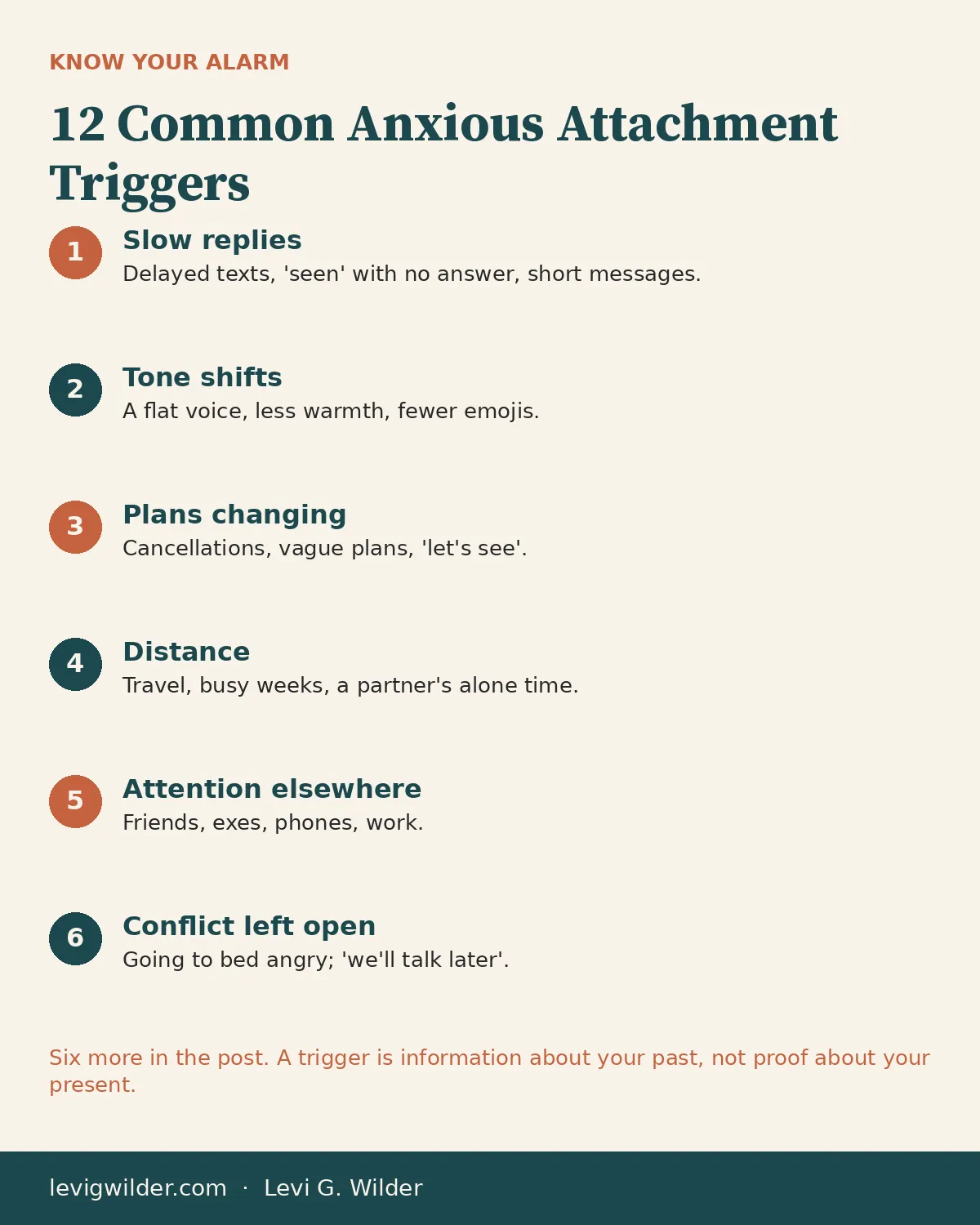
- Anxious attachment: "They took ages to reply. They're losing interest." "If I don't hear from them tonight, it means something's wrong." "I need them to tell me we're OK."
- Relationship OCD: "I didn't feel a rush of love when they walked in. What if that means I don't love them?" "Their laugh annoyed me. What if I'm settling?" "I have to work out, for certain, whether this is right before I can relax."
Notice the direction. Anxious attachment thoughts usually point outward, at the partner's interest and availability. ROCD thoughts often point inward, at your own feelings, or at the partner's flaws, and they demand a level of certainty that no real relationship can give.
Notice the timing too. Anxious attachment tends to flare when something changes in the connection. ROCD can flare at any time, including your happiest moments, because the doubt itself is the trigger.
How can you tell ROCD and anxious attachment apart?
No list can diagnose you, but these questions often point in one direction or the other.
| Anxious attachment | Relationship OCD | |
|---|---|---|
| Main fear | Being left, rejected or loved less | Being with the wrong person, not loving them "enough", making a mistake |
| Whose feelings you doubt | Mostly theirs | Often your own |
| What triggers it | Distance: slow replies, cancelled plans, a change in tone | Anything: a flaw you notice, a stray thought, a happy couple online, even a calm moment |
| How the thought feels | Painful, but it fits what you believe about yourself | Intrusive and unwanted; it feels wrong to have it |
| Typical behaviour | Seeking closeness, protest behaviour, checking their activity | Checking your own feelings, comparing, mental reviewing, seeking certainty |
| What brings relief | Felt connection and responsiveness | Short relief from reassurance, then the doubt returns or shifts |
A simple test: when your partner is warm, close and reliable for a week, does the fear mostly settle? If so, attachment anxiety is likely doing most of the work. If the doubts stay or even grow when things are calm, an OCD process is more likely.
Why do the two overlap so often?
Because they feed each other. In Doron's research, relationship-centred obsessive-compulsive symptoms were linked to attachment anxiety (Doron et al., 2012). That makes sense. If you already fear losing love, a stray doubt about the relationship can feel extra dangerous, and the urge to settle it can feel urgent.
Both also run on reassurance-seeking, which is why they're easy to confuse. Research on reassurance in OCD and anxiety disorders found that people with OCD sought reassurance more intensely and repetitively, often aimed at removing doubt or preventing harm, while people with anxiety disorders tended to seek it in other ways (Kobori & Salkovskis, 2013). In attachment research, excessive reassurance-seeking is linked with attachment anxiety and with relationship and mood problems (Shaver, Schachner & Mikulincer, 2005).
So the behaviour can look the same from the outside. The difference is what the reassurance is for: closeness, or certainty.
What helps anxious attachment?
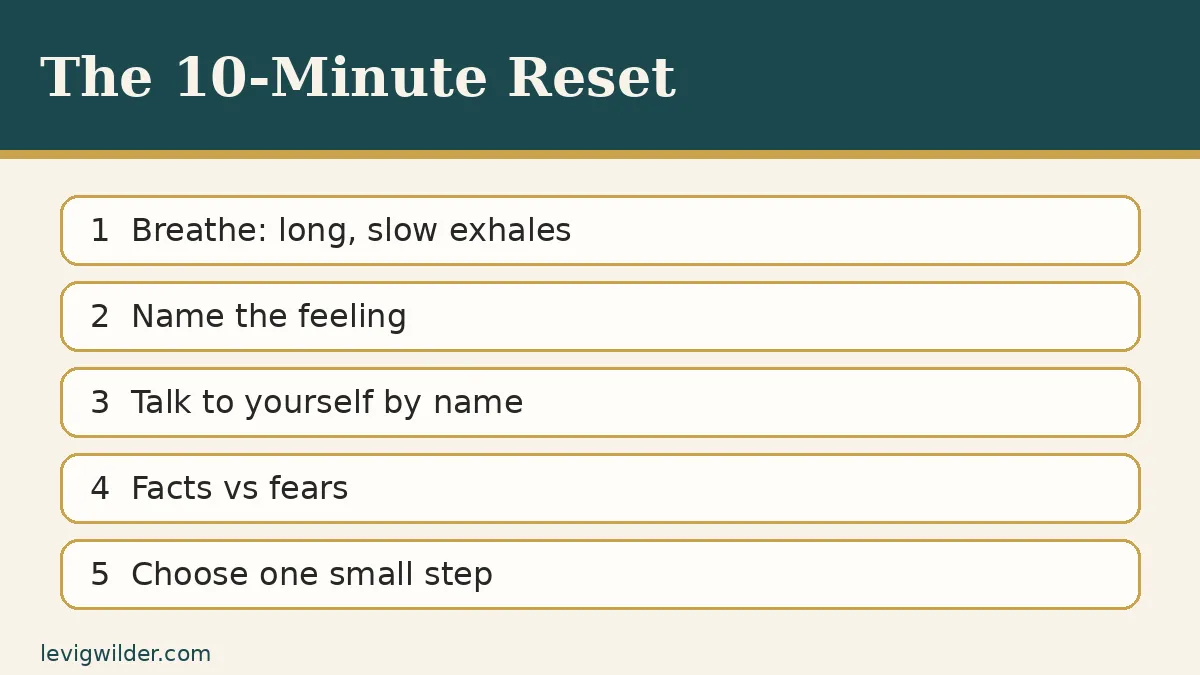
- Calm your body first. When the alarm fires, slow breathing with a longer exhale helps bring arousal down before you act. Our guide on how to calm anxious attachment thoughts has a 10-minute reset.
- Separate facts from fears. "They haven't replied in three hours" is a fact. "They're losing interest" is a fear.
- Ask clearly instead of testing. A direct, kind request ("Can we have a call tonight? I've missed you") works better than protest behaviour.
- Choose responsive people. Over time, experiences with a reliable partner can shift attachment toward security (Arriaga et al., 2018). See can anxious attachment be cured?
What helps relationship OCD?
- Treat it as OCD. ROCD is treated like other OCD, mainly with cognitive behavioural therapy including exposure and response prevention (ERP), which has strong evidence for OCD (Öst et al., 2015; IOCDF).
- Stop trying to answer the doubt. The goal isn't to prove you love them. It's to let the question sit there unanswered while you keep living your life together.
- Cut back reassurance gradually. Agree with your partner on a plan, so they can respond with warmth without answering the same question again.
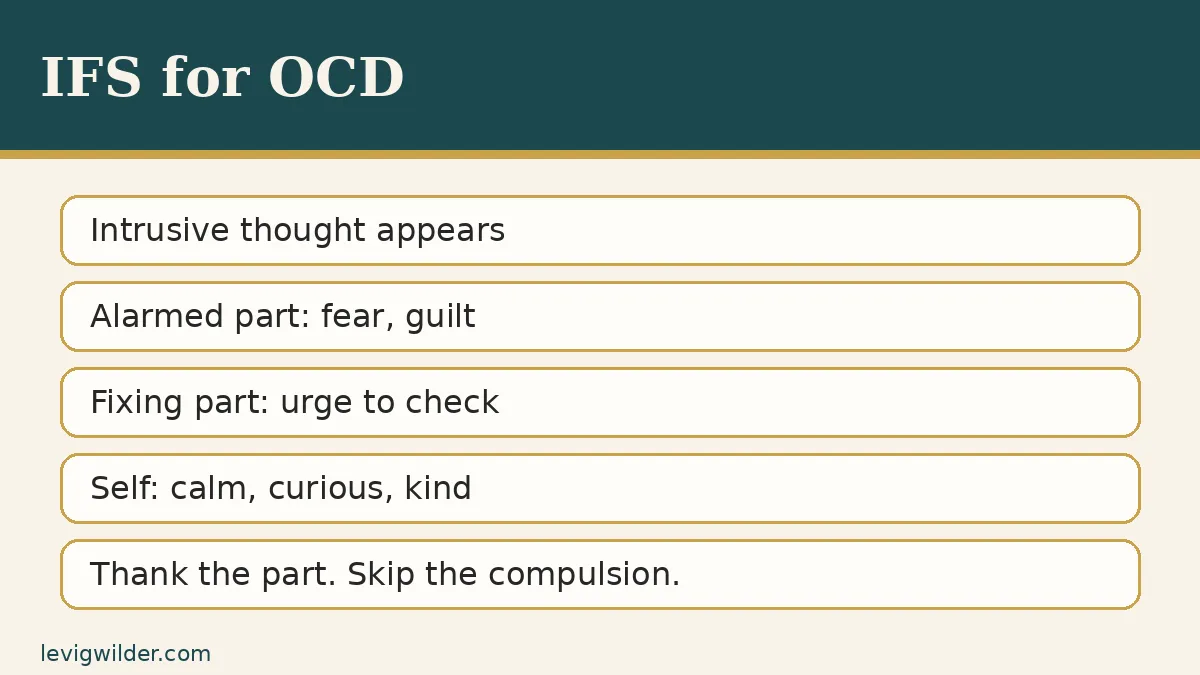
- Relate to the thought differently. Many people find it easier to tolerate doubt when they see it as a scared part trying to protect them. IFS for OCD explains this approach and how to use it without feeding compulsions.
The International OCD Foundation has a clinician-written overview of relationship OCD that's worth reading too.
What if you have both?
That's common, and it's workable. A useful order is:
- If OCD-style compulsions are taking a lot of time, get OCD-informed help first. Reassurance won't calm ROCD for long, and it'll keep the loop going.
- Alongside that, build attachment skills: naming feelings, self-soothing, and making clear requests for connection.
- Talk with your partner in a calm moment. Explain the pattern without making them responsible for fixing it.
If your anxious attachment grew out of a childhood where your feelings went unnoticed, Loved but Never Seen (printable workbook) offers step-by-step practices and a 30-day plan. For the OCD side, The IFS Workbook for OCD is on Google Play Books. Both are on the books page.
FAQ
What is the difference between ROCD and anxious attachment?
Anxious attachment mainly fears losing the partner's love. ROCD involves intrusive, unwanted doubts about your own feelings, the rightness of the relationship or your partner's flaws, followed by compulsions such as checking, comparing or seeking reassurance to feel certain.
Can you have both ROCD and anxious attachment?
Yes. Research on relationship-centred obsessive-compulsive symptoms has found links with attachment anxiety, and many people notice features of both.
Is ROCD a real diagnosis?
ROCD is not a separate diagnosis in the DSM. It is a term researchers and clinicians use for OCD whose obsessions focus on a relationship or partner. It is diagnosed and treated as OCD.
How is relationship OCD treated?
It is usually treated like other forms of OCD, mainly with cognitive behavioural therapy including exposure and response prevention (ERP), which helps you tolerate doubt without doing compulsions.
Does reassurance help ROCD or anxious attachment?
Reassurance tends to give short relief and then the doubt returns. In OCD it usually feeds the cycle. In anxious attachment, a clear, calm request for connection can help, but repeated reassurance-seeking often backfires.
Sources
- Arriaga, X. B., Kumashiro, M., Simpson, J. A., & Overall, N. C. (2018). Revising working models across time: Relationship situations that enhance attachment security. Personality and Social Psychology Review, 22, 71–96. https://doi.org/10.1177/1088868317705257
- Doron, G., Derby, D. S., & Szepsenwol, O. (2014). Relationship obsessive compulsive disorder (ROCD): A conceptual framework. Journal of Obsessive-Compulsive and Related Disorders, 3, 169–180. https://doi.org/10.1016/j.jocrd.2013.12.005
- Doron, G., Derby, D. S., Szepsenwol, O., & Talmor, D. (2012). Tainted love: Exploring relationship-centered obsessive compulsive symptoms in two non-clinical cohorts. Journal of Obsessive-Compulsive and Related Disorders, 1, 16–24. https://doi.org/10.1016/j.jocrd.2011.11.002
- Fraley, R. C., Waller, N. G., & Brennan, K. A. (2000). An item response theory analysis of self-report measures of adult attachment. Journal of Personality and Social Psychology, 78, 350–365. https://doi.org/10.1037/0022-3514.78.2.350
- International OCD Foundation. Exposure and Response Prevention (ERP). https://iocdf.org/about-ocd/treatment/erp/
- Kobori, O., & Salkovskis, P. M. (2013). Patterns of reassurance seeking and reassurance-related behaviours in OCD and anxiety disorders. Behavioural and Cognitive Psychotherapy, 41, 1–23. https://doi.org/10.1017/S1352465812000665
- Mikulincer, M., & Shaver, P. R. (2003). The attachment behavioral system in adulthood. Advances in Experimental Social Psychology, 35, 53–152. https://doi.org/10.1016/S0065-2601(03)01002-5
- Öst, L.-G., Havnen, A., Hansen, B., & Kvale, G. (2015). Cognitive behavioral treatments of obsessive–compulsive disorder. Clinical Psychology Review, 40, 156–169. https://doi.org/10.1016/j.cpr.2015.06.003
- Shaver, P. R., Schachner, D. A., & Mikulincer, M. (2005). Attachment style, excessive reassurance seeking, relationship processes, and depression. Personality and Social Psychology Bulletin, 31, 343–359. https://doi.org/10.1177/0146167204271709