IFS for OCD: How Parts Work Can Help With Intrusive Thoughts
OCDInternal Family SystemsIntrusive Thoughts
Quick answer
Can IFS therapy help OCD?
IFS (Internal Family Systems) treats OCD symptoms as the work of protective "parts" trying to keep you safe. It can help you relate to intrusive thoughts and urges with curiosity instead of panic. But IFS has no published controlled trials for OCD yet, so use it alongside ERP, the first-line treatment, not instead of it.
By Levi G. Wilder. I'm a researcher and trauma survivor, not a therapist. This article is education, not diagnosis or treatment. If OCD is taking hours of your day, please talk to a clinician trained in OCD.
If you live with OCD, you probably know the loop. A thought shows up that feels wrong or dangerous. Anxiety spikes. Something in you insists you check, wash, confess, pray, review or ask one more time. It works for a minute, and then the loop starts again.
Internal Family Systems, usually shortened to IFS, offers a different way of looking at that loop. Instead of seeing yourself as broken, it sees a set of "parts" that are all trying, clumsily, to protect you. This article explains what IFS is, what the research actually shows, and how to use it in a way that supports the treatment with the strongest evidence for OCD rather than competing with it.
What is IFS, in plain language?
IFS was developed by family therapist Richard Schwartz. Its basic idea is that the mind is naturally made of many sub-personalities, which it calls parts. You've probably noticed this yourself: "part of me wants to go, part of me wants to stay home." IFS takes that everyday language seriously (IFS Institute).
IFS groups parts roughly like this:
- Exiles carry old pain, fear or shame.
- Managers try to prevent that pain from ever surfacing, by planning, controlling, checking or criticising.
- Firefighters jump in when pain breaks through anyway, with fast, urgent actions to make the feeling stop.
Underneath the parts, IFS describes a Self: a calm, curious and compassionate state that everyone has, even if it's hard to reach. The goal of IFS isn't to get rid of parts. It's to help them trust the Self enough to relax.
How does OCD look through an IFS lens?
Here is how the OCD loop can be mapped onto parts. This is a way of thinking about your experience, not a scientific explanation of what causes OCD.
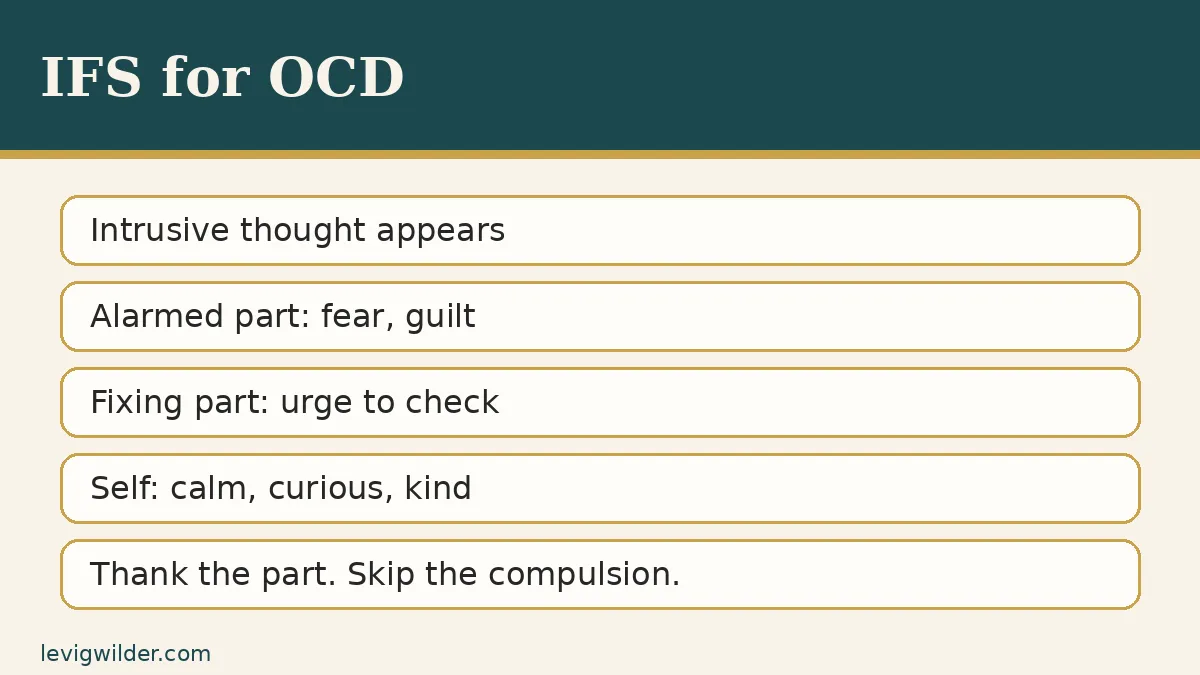
- The intrusive thought. A sudden image or idea: "What if I hit someone with the car?" "What if I don't really love my partner?"
- The alarmed part. A part that treats the thought as proof of danger and floods you with fear, guilt or disgust.
- The fixing part. A part that pushes for a compulsion: checking, washing, mental reviewing, asking for reassurance, avoiding.
- The critic. Often there's also a part that attacks you for having the thought at all.
Seen this way, the compulsion isn't a character flaw. It's a protective part doing the only thing it knows to bring the alarm down. The problem is that compulsions teach the brain that the thought really was dangerous, so the alarm comes back stronger. That's the same trap ERP is designed to break.
It's also worth knowing that intrusive thoughts themselves are normal. In a classic study, Rachman and de Silva found that most people without OCD reported unwanted intrusive thoughts similar in content to clinical obsessions (Rachman & de Silva, 1978). The difference in OCD is how much meaning and alarm get attached to the thought, and what you then feel you must do about it.
What does the research say about IFS for OCD?
Here's the honest picture, because you deserve it before you spend time or money on anything.
ERP has the strongest evidence. Exposure and response prevention is a form of cognitive behavioural therapy in which you gradually face feared thoughts and situations while resisting compulsions. A large meta-analysis of cognitive behavioural treatments for OCD found large effects compared with waitlist and placebo conditions (Öst et al., 2015). In the UK, NICE guidance recommends CBT including ERP as a core treatment for OCD (NICE CG31). The International OCD Foundation describes ERP as the gold-standard psychological treatment (IOCDF).
IFS has early, promising research, but not for OCD yet. Small studies have tested IFS for other problems:
- A pilot study found reductions in depression symptoms among female college students who received IFS (Haddock et al., 2017).
- A randomised controlled trial of an IFS-based programme for people with rheumatoid arthritis found improvements in pain and depressive symptoms (Shadick et al., 2013).
- A small pilot study of IFS for PTSD in survivors of multiple childhood traumas reported reductions in PTSD symptoms (Hodgdon et al., 2022).
I haven't found a published controlled trial of IFS specifically for OCD. That doesn't mean it can't help. It means we don't know yet how well it works, for whom, or whether it adds anything to ERP. Anyone who tells you IFS "cures" OCD is going beyond the evidence.
Why might parts work still help people with OCD?
Even without OCD-specific trials, there are sensible reasons people find IFS ideas useful alongside standard treatment:
- It lowers shame. "A part of me is having a terrifying thought" lands very differently from "I am a terrible person." Many people with OCD carry heavy shame about the content of their thoughts, and shame makes exposures harder to face.
- It creates a little distance. Naming a part puts a small gap between you and the urge. That gap is where you get to choose not to do the compulsion.
- It treats the urge with respect. ERP asks you to resist compulsions. IFS lets you thank the part that wants to do them for trying to protect you, while still not following its orders. Some people find that makes ERP feel less like a fight with themselves.
- It can reach older pain. For people whose OCD sits on top of trauma or emotional neglect, IFS offers a way to notice the younger, frightened parts that may be fuelling the alarm.
How can you use IFS without feeding compulsions?
This is the most important section. OCD is very good at turning any helpful tool into a new ritual. Parts work can become another way to analyse a thought, argue with it, or try to get certainty. Here's how to keep it on the right side of that line.
- Don't ask parts whether the thought is true. The aim is never to settle the doubt. If you notice yourself questioning a part to find out whether you're "really" dangerous, that's a compulsion in disguise.
- Keep it short. A two-minute check-in is enough. Long, repeated sessions about the same fear can become mental reviewing.
- Pair it with response prevention. Notice the part, acknowledge it, and then don't do the compulsion. The IFS step is there to help you tolerate the discomfort, not to make it go away.
- Watch for "just right" pressure. If you feel you have to do the parts exercise perfectly before you can move on, stop and move on anyway.
- Get support when it's heavy. If OCD is severe, or if trauma memories come up, work with a clinician. In the US, the IOCDF has a directory of OCD-trained providers.
What does a short IFS check-in for an intrusive thought look like?
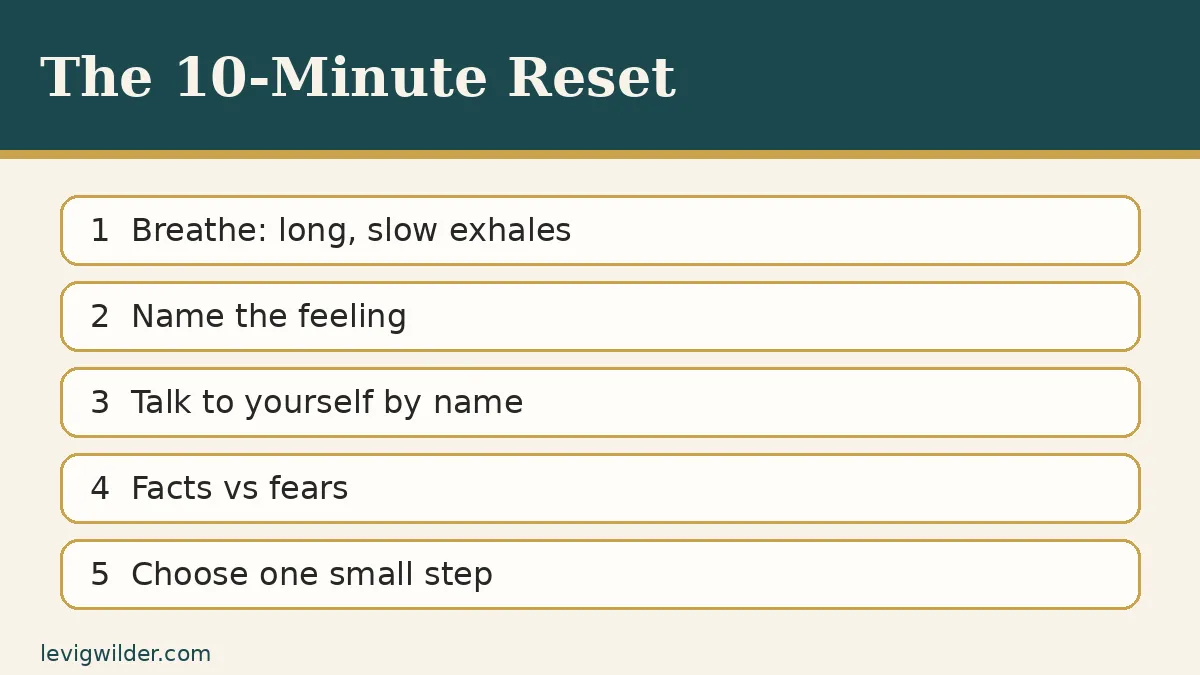
Here is a simple five-step practice that fits alongside ERP. Use it when a thought shows up and the urge to neutralise it is strong.
- Notice. "There's the thought. There's the urge to check."
- Name the part. "A part of me is scared. A part of me wants to check the stove again."
- Find it in your body. Where do you feel it? Tight chest, buzzing hands, a knot in your stomach? Just notice, without trying to fix it.
- Get curious. Ask the part, gently: "What are you afraid would happen if you stopped?" Listen for the feeling, not for proof. Often the answer is something like "you'd be blamed" or "you'd lose everyone."
- Thank it and choose. "Thanks for trying to protect me. I'm not going to check right now. You can stay with me while I don't." Then return to what you were doing, and let the anxiety rise and fall on its own.
Notice what the practice doesn't do. It doesn't argue with the thought, prove it wrong, or ask anyone for reassurance. That's what keeps it compatible with ERP.
Is IFS right for you?
IFS ideas may be a good fit if:
- shame about your thoughts makes it hard to start or stay in ERP;
- your OCD seems tied up with trauma, emotional neglect or a harsh inner critic;
- you're already in treatment and want a kinder way to talk to yourself between sessions.
Be more careful if:
- you haven't tried ERP yet: start there, or at least alongside;
- you tend to get stuck in long mental reviewing: keep parts work very short;
- you're in crisis or not sleeping or eating: please get professional help first.
Where can you go from here?
If you'd like a structured, self-led way to try these ideas, I wrote The IFS Workbook for OCD (ebook on Google Play Books). It presents IFS as a complement to ERP, not a replacement, and walks through parts mapping, Self-energy practices and exposure-friendly exercises. There's also a free IFS–OCD companion and a free set of 50 journal prompts for OCD. You can see all of my books and printables on the books page.
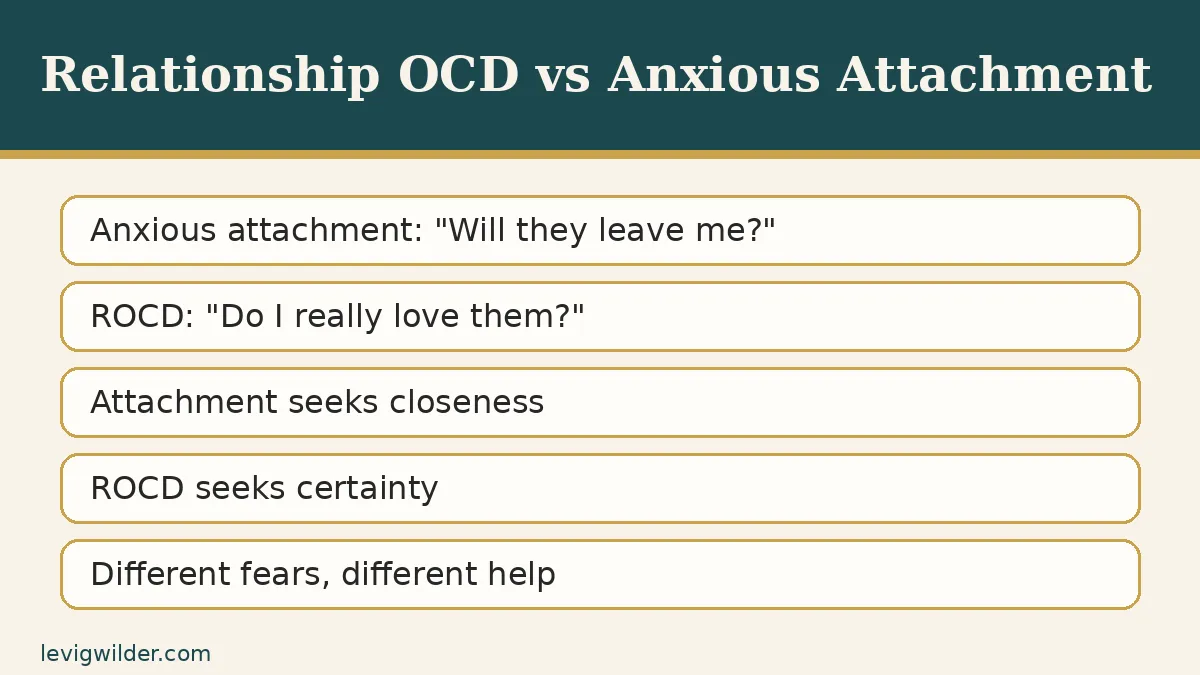
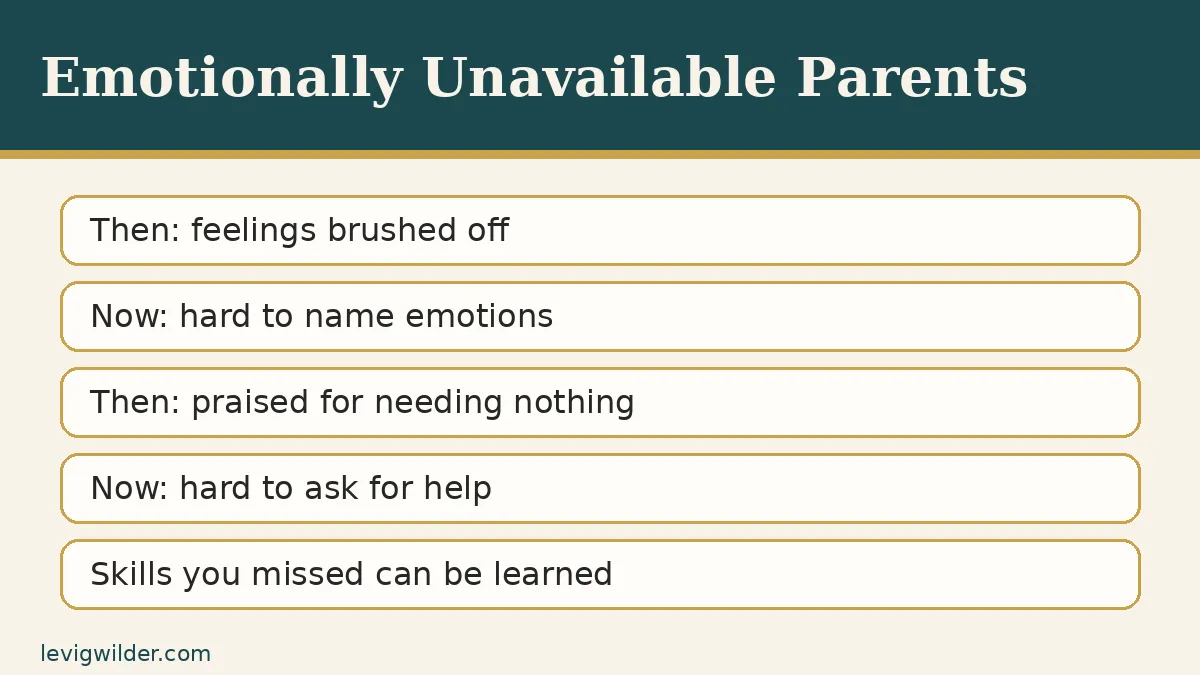
If your intrusive thoughts are about your relationship, read Relationship OCD vs anxious attachment next. And if a harsh inner voice goes back to a childhood where your feelings weren't noticed, emotional neglect vs emotional abuse may help put words to it.
FAQ
Can IFS therapy help OCD?
IFS may help some people relate to intrusive thoughts and compulsive urges with less fear and shame. But there are no published controlled trials of IFS for OCD yet, so it is best used alongside exposure and response prevention (ERP), not as a replacement.
Is IFS better than ERP for OCD?
No. ERP is the first-line psychological treatment for OCD with strong evidence from many trials. IFS has early, promising research in other conditions only. Many people use IFS ideas to make ERP feel less harsh.
What is a part in IFS?
A part is a sub-personality with its own feelings and goals, such as a part that worries, a part that checks, or a part that feels ashamed. IFS assumes every part is trying to help, even when its methods cause problems.
Can IFS make OCD worse?
It can if parts work turns into a new way to analyse, neutralise or seek certainty about a thought. Keep sessions short, notice the urge to get it "just right", and work with an OCD-trained clinician when possible.
Can I do IFS for OCD on my own?
Many people practise basic IFS skills on their own with a workbook, especially noticing and naming parts. For moderate or severe OCD, a clinician who knows both ERP and IFS is the safer choice.
Sources
- Haddock, S. A., Weiler, L. M., Trump, L. J., & Henry, K. L. (2017). The efficacy of Internal Family Systems therapy in the treatment of depression among female college students: A pilot study. Journal of Marital and Family Therapy, 43, 131–144. https://doi.org/10.1111/jmft.12184
- Hodgdon, H. B., Anderson, F. G., Southwell, E., Hrubec, W., & Schwartz, R. (2022). Internal Family Systems (IFS) therapy for posttraumatic stress disorder (PTSD) among survivors of multiple childhood trauma: A pilot effectiveness study. Journal of Aggression, Maltreatment & Trauma, 31, 22–43. https://doi.org/10.1080/10926771.2021.2013375
- IFS Institute. What is Internal Family Systems? https://ifs-institute.com/
- International OCD Foundation. Exposure and Response Prevention (ERP). https://iocdf.org/about-ocd/treatment/erp/
- National Institute for Health and Care Excellence (2005). Obsessive-compulsive disorder and body dysmorphic disorder: treatment (CG31). https://www.nice.org.uk/guidance/cg31
- Öst, L.-G., Havnen, A., Hansen, B., & Kvale, G. (2015). Cognitive behavioral treatments of obsessive–compulsive disorder: A systematic review and meta-analysis of studies published 1993–2014. Clinical Psychology Review, 40, 156–169. https://doi.org/10.1016/j.cpr.2015.06.003
- Rachman, S., & de Silva, P. (1978). Abnormal and normal obsessions. Behaviour Research and Therapy, 16, 233–248. https://doi.org/10.1016/0005-7967(78)90022-0
- Shadick, N. A., et al. (2013). A randomized controlled trial of an Internal Family Systems-based psychotherapeutic intervention on outcomes in rheumatoid arthritis. The Journal of Rheumatology, 40, 1831–1841. https://doi.org/10.3899/jrheum.121465