Emotional Neglect vs Emotional Abuse: The Difference (and Why Both Matter)
Childhood Emotional NeglectEmotional AbuseHealing
Quick answer
Is emotional neglect a form of abuse?
Emotional abuse is about what was done to you: shaming, threatening, mocking or rejecting. Emotional neglect is about what was not done for you: your feelings were not noticed, named or responded to often enough. Researchers group both as psychological maltreatment, and both can leave lasting effects on self-worth, emotions and relationships in adulthood.
By Levi G. Wilder. I'm a researcher and a survivor of childhood emotional neglect, not a therapist. This post is education, not diagnosis or treatment.
For years I told myself I had no right to call my childhood "hard". Nobody hit me. Nobody screamed insults at me. When I read about emotional abuse, I didn't recognize my house. And yet I grew into an adult who couldn't tell you what he felt, who apologized for needing anything, and who felt strangely alone in rooms full of people who loved him.
What I was missing was a word for the other thing: emotional neglect. If you've ever typed "emotional neglect vs emotional abuse" into Google at 1 a.m., you're probably trying to work out the same thing I was. Which one was mine? Does it "count"? Let's go through it calmly.
The short answer
Emotional abuse is about what was done to you. Emotional neglect is about what was not done for you. Abuse is an act: shaming, threatening, mocking, rejecting. Neglect is an absence: your feelings were not noticed, named, asked about or responded to often enough.
Both are forms of what researchers call psychological maltreatment. In a widely cited framework, child psychiatrist Danya Glaser describes emotional abuse and neglect as patterns in the parent–child relationship. They don't require physical contact, and they don't require anyone to have intended harm (Glaser, 2002). That last part matters. Many parents who emotionally neglected their kids loved them and believed they were doing fine.

What emotional abuse looks like
Emotional abuse is active. You can usually point to things that happened:
- Being called names, belittled or humiliated, especially in front of others.
- Threats: of abandonment, of punishment, of "you'll see what happens".
- Your feelings being mocked ("crybaby", "so dramatic") or used against you later.
- Constant criticism, blame, or being made responsible for an adult's moods.
- Love that was given and withdrawn as a tool for control.
People who grew up with emotional abuse often carry fear into adulthood: a body that braces for criticism, a habit of scanning faces for anger, a loud inner critic that sounds a lot like someone from the past.
What emotional neglect looks like
Emotional neglect is quieter. Psychologist Jonice Webb, who popularized the term "Childhood Emotional Neglect" in her book Running on Empty, defines it as a parent's failure to respond enough to a child's emotional needs (Webb, 2012). Notice the word "enough". It isn't about one bad day. It's a pattern.
It can look like:
- Nobody asking how you felt, or the question being "Are you okay?" with only one acceptable answer.
- Sadness being met with a change of subject, anger with silence, fear with "don't be silly".
- Good care on paper: food, school, birthday presents, but little curiosity about your inner world.
- Parents who were busy, depressed, grieving, overwhelmed, or simply never taught emotional language themselves.
- Learning early that the easiest child is the one with no problems, so you became that child.
The hardest part of emotional neglect is that it leaves few memories. You can't remember something that didn't happen. That's why so many people with this history say, "But my childhood was fine."
Five key differences
1. Presence vs absence
Abuse adds something harmful. Neglect leaves out something necessary. A useful image: abuse is a storm, neglect is a drought. Both damage the garden, in different ways.
2. Memorable vs invisible
Abuse tends to produce specific memories. Neglect produces a feeling, often a vague sense of being on your own, without a story attached.
3. What the adult feels
Survivors of abuse often describe fear, shame and hypervigilance. Survivors of neglect more often describe emptiness, numbness, "I don't know what I feel", and a sense of being fundamentally different from others. These overlap a lot, but the flavors are worth noticing.
4. Intent
Abuse can be intentional or not. Neglect is very often unintentional, which makes it harder to name because naming it can feel like betraying a parent who tried.
5. How it gets recognized
Abuse is more often recognized by others: teachers, relatives, professionals. Emotional neglect is rarely noticed from the outside, because the child usually looks fine. Researchers Stoltenborgh, Bakermans-Kranenburg and van IJzendoorn titled their large review of neglect research "The neglect of child neglect" for exactly this reason (Stoltenborgh et al., 2013).
How common is emotional neglect?
More common than most people think. In that same meta-analysis, self-report studies found emotional neglect at about 184 per 1,000 people, close to one in five (Stoltenborgh et al., 2013). In the second wave of the CDC–Kaiser Permanente ACE Study, which included about 8,600 adults, 14.8% reported emotional neglect (CDC, "About the CDC-Kaiser ACE Study"). Numbers vary with how questions are asked, but the message is consistent: if this is your story, you are far from alone.
They often overlap
Many people experienced both. A parent can be cold most of the time and cruel when stressed. A home can have one abusive parent and one who looked away, which is its own kind of neglect. You don't have to pick a single box. The point of these words isn't to rank pain. It's to help you understand what you needed and didn't get, so you can start giving it to yourself now.
"But was it bad enough to matter?"
This is the question I hear most, and the one I asked myself for years. Research gives a surprisingly kind answer.
First, quiet does not mean minor. A meta-analysis of 12 studies found that psychological abuse and neglect, sometimes called "silent" forms of maltreatment, showed the strongest association with depression among the types studied (Infurna et al., 2016). A larger review of 124 studies linked neglect with higher odds of depression and suicide attempts (Norman et al., 2012). These are associations, not destinies. Plenty of people with these histories do well. But it means the effects are real.
Second, how you experienced your childhood matters. In a long-running study of 1,196 people, the risk of later mental-health problems was linked mainly to people's own subjective experience of maltreatment, more than to official records alone (Danese & Widom, 2020). Another study found that what people remember and what was recorded at the time often disagree (Baldwin et al., 2019). You don't need to prove your past to a courtroom before you're allowed to heal from it.
What both leave behind in adults
Whatever the mix, the research, and my own life, point to the same few patterns again and again:
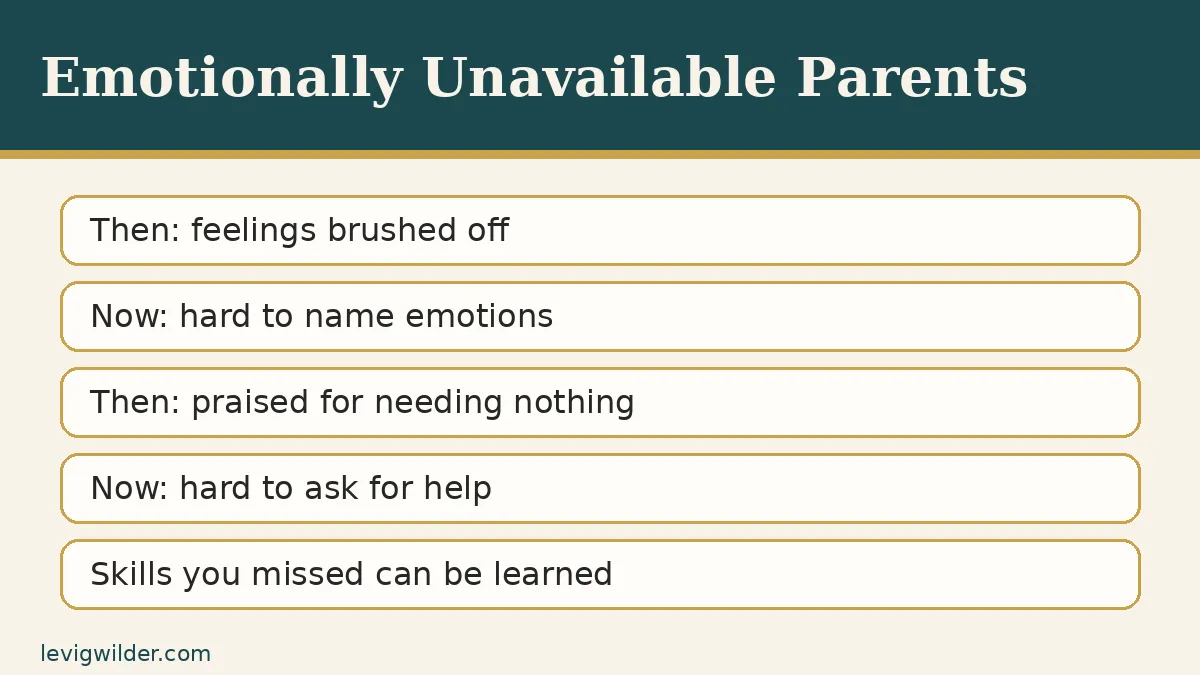
- Trouble naming feelings. A large meta-analysis found a real but modest link between childhood maltreatment, including emotional neglect, and difficulty identifying feelings (Ditzer et al., 2023).
- Not asking for help, and feeling like a burden when you do.
- Harsh self-talk, or a flat sense of not mattering much.
- Relationships that feel either too far or too scary: keeping people at arm's length, or clinging with anxiety.
If any of these fit, they're not character flaws. They're adaptations: smart solutions a child found for a situation they couldn't change.
Where to start (gently)
Name it in one sentence
Try: "What I needed and didn't get enough of was ___." For abuse, you may add: "What I got instead was ___." Write it down. Don't edit it for fairness yet. Fairness can come later.
Practice noticing one feeling a day
Putting feelings into words is linked to reduced activity in the brain's alarm response (Lieberman et al., 2007). Start tiny: once a day, pause and ask, "What am I feeling right now, and where in my body?" Even "something tight in my chest, maybe worry" counts.
Talk to someone trained, if you can
If your history includes abuse, or if you're struggling with depression, self-harm or thoughts of suicide, please reach out to a licensed professional or a local crisis line. Self-help is a complement, not a replacement.
If you want a structured, step-by-step path, I wrote The Emotional Neglect Workbook for exactly this: understanding what was missing, learning to name and feel emotions, and building the self-care you never got. It's ebook on Google Play Books, and the printable PDF edition is here.
Not ready for a book? Start with the free printable companion pack: worksheets you can use alongside this post.
FAQ
Is emotional neglect a form of abuse?
Many researchers group both under "psychological maltreatment" (Glaser, 2002). In everyday language, neglect is usually described as separate from abuse because it is an absence rather than an act. Both can have lasting effects.
Can loving parents emotionally neglect a child?
Yes. Emotional neglect is often unintentional. Parents who were overwhelmed, unwell, or never taught emotional language themselves can provide good physical care while missing a child's emotional needs.
How do I know if I experienced emotional neglect?
Common signs include trouble naming feelings, discomfort asking for help, and a sense of being different or empty. A reflection checklist can help you notice patterns, but only a qualified professional can assess your situation.
Can you heal from childhood emotional neglect?
Many people build the skills they missed in adulthood, such as naming feelings, self-compassion and asking for support. Progress usually comes from small, repeated practice rather than one breakthrough.
Sources
- Baldwin, J. R., et al. (2019). Agreement between prospective and retrospective measures of childhood maltreatment. JAMA Psychiatry, 76, 584–593. https://doi.org/10.1001/jamapsychiatry.2019.0097
- Centers for Disease Control and Prevention. About the CDC-Kaiser ACE Study. https://www.cdc.gov/violenceprevention/aces/about.html
- Danese, A., & Widom, C. S. (2020). Objective and subjective experiences of child maltreatment and their relationships with psychopathology. Nature Human Behaviour, 4, 811–818. https://doi.org/10.1038/s41562-020-0880-3
- Ditzer, J., et al. (2023). Child maltreatment and alexithymia: A meta-analytic review. Psychological Bulletin, 149, 311–329. https://doi.org/10.1037/bul0000391
- Glaser, D. (2002). Emotional abuse and neglect (psychological maltreatment): A conceptual framework. Child Abuse & Neglect, 26, 697–714. https://doi.org/10.1016/S0145-2134(02)00342-3
- Infurna, M. R., et al. (2016). Associations between depression and specific childhood experiences of abuse and neglect: A meta-analysis. Journal of Affective Disorders, 190, 47–55. https://doi.org/10.1016/j.jad.2015.09.006
- Lieberman, M. D., et al. (2007). Putting feelings into words. Psychological Science, 18, 421–428. https://doi.org/10.1111/j.1467-9280.2007.01916.x
- Norman, R. E., et al. (2012). The long-term health consequences of child physical abuse, emotional abuse, and neglect. PLoS Medicine, 9, e1001349. https://doi.org/10.1371/journal.pmed.1001349
- Stoltenborgh, M., Bakermans-Kranenburg, M. J., & van IJzendoorn, M. H. (2013). The neglect of child neglect. Social Psychiatry and Psychiatric Epidemiology, 48, 345–355. https://doi.org/10.1007/s00127-012-0549-y
- Webb, J. (2012). Running on Empty: Overcome Your Childhood Emotional Neglect. Morgan James.
Related reading: Childhood emotional neglect self-check · Why do I feel like a burden?