11 Signs You Had Emotionally Unavailable Parents (and How It Shows Up Now)
Childhood Emotional NeglectParentsSelf-Worth
Quick answer
What are emotionally unavailable parents?
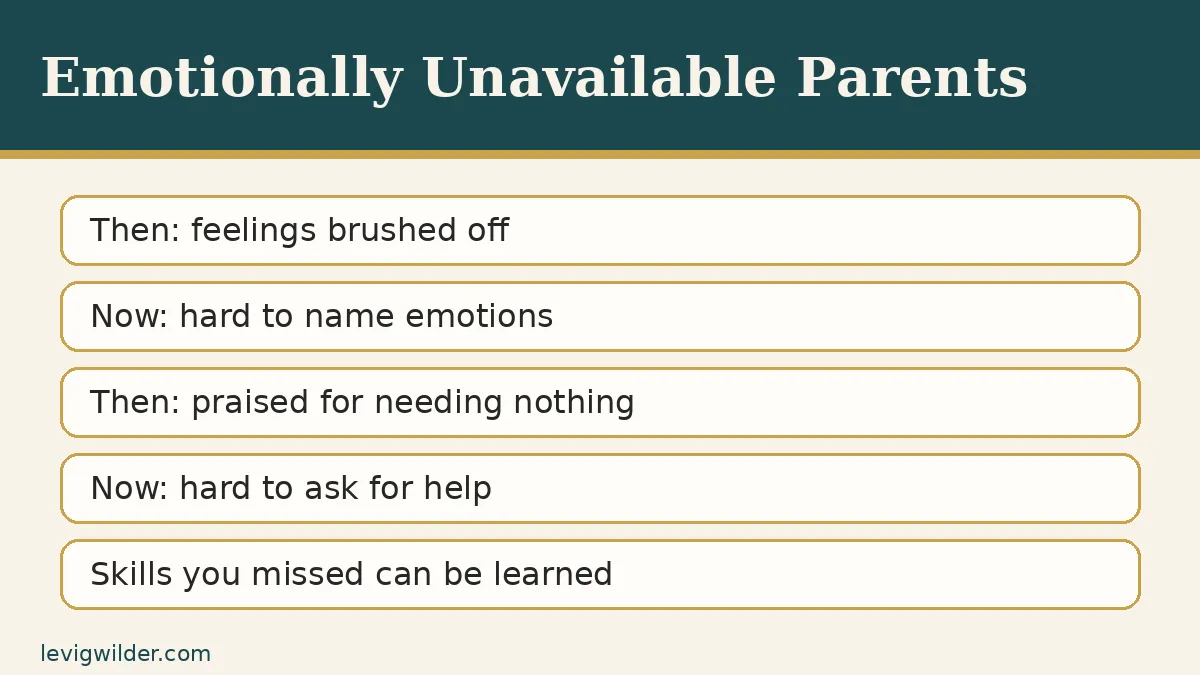
Emotionally unavailable parents met physical needs but rarely noticed, named or responded to a child's feelings. Signs include feelings being ignored or brushed off, little comfort when upset, and being praised for needing nothing. As adults, people often struggle to name emotions, ask for help or feel close. These skills can be learned later.
By Levi G. Wilder. I'm a researcher and a survivor of childhood emotional neglect, not a therapist. This list is for reflection, not diagnosis.
Some people search for this phrase because they finally have words for something that always felt off. There was food on the table, maybe good schools and birthday parties, but no one really asked how you were. Or they asked, and the honest answer wasn't welcome.
"Emotionally unavailable parents" isn't a clinical term, but it describes a real and well-studied experience. Researchers usually call it emotional neglect: a pattern in which a child's emotional needs go unnoticed or unanswered (Glaser, 2002). Below are eleven common signs, how they tend to show up in adult life, and some gentle first steps.
What does "emotionally unavailable" actually mean?
An emotionally available parent notices a child's feelings, helps put words to them, and responds with comfort or guidance often enough that the child learns feelings are safe and manageable. Gottman, Katz and Hooven described this as "emotion coaching": parents who were aware of emotions and helped their children name and handle them had children who regulated their emotions better (Gottman, Katz & Hooven, 1996). A broad review of research on parental socialisation of emotion reached a similar conclusion: how parents react to children's emotions shapes how children learn to understand and manage their own (Eisenberg, Cumberland & Spinrad, 1998).
An emotionally unavailable parent isn't necessarily cold or cruel. They might be busy, depressed, grieving, anxious, ill, or simply raised in a family where nobody talked about feelings. The key point is what was missing, not what was done. If you're unsure whether your experience was neglect or abuse, emotional neglect vs emotional abuse explains the difference.
What are the 11 signs you had emotionally unavailable parents?
You don't need all of them. Notice which ones land.
- Your feelings were brushed off. "You're fine." "Don't be silly." "There's nothing to cry about." Sadness or fear got a quick fix or a change of subject.
- You were comforted rarely, or not at all. When you were upset, you went to your room and waited for it to pass.
- Emotions weren't discussed at home. Nobody asked, "How did that feel?" Big family events, such as a death, a move or a divorce, happened without anyone talking about them.
- You were praised for being "easy". The child who needed nothing got the approval. Needing things felt risky.
- Your parents knew your grades but not your inner life. They could list your achievements but not your fears, crushes or what made you laugh.
- You learned to look after them. You watched a parent's mood, calmed them down, or kept problems to yourself so you wouldn't add to their stress.
- Anger or tears made them withdraw. Strong feelings led to silence, a closed door, or a parent who seemed to vanish emotionally.
- Help came with a sigh. When you did ask for something, it seemed to cost them, so you stopped asking.
- Physical care was good, but you still felt alone. Clothes, meals and rides were fine. The loneliness was harder to explain, which made it harder to name.
- Conflict was avoided or never repaired. Arguments were dropped rather than resolved, and no one said sorry or talked it through afterwards.
- You can't remember feeling deeply known. When you look back, you can't recall a time a parent really understood what was going on inside you.
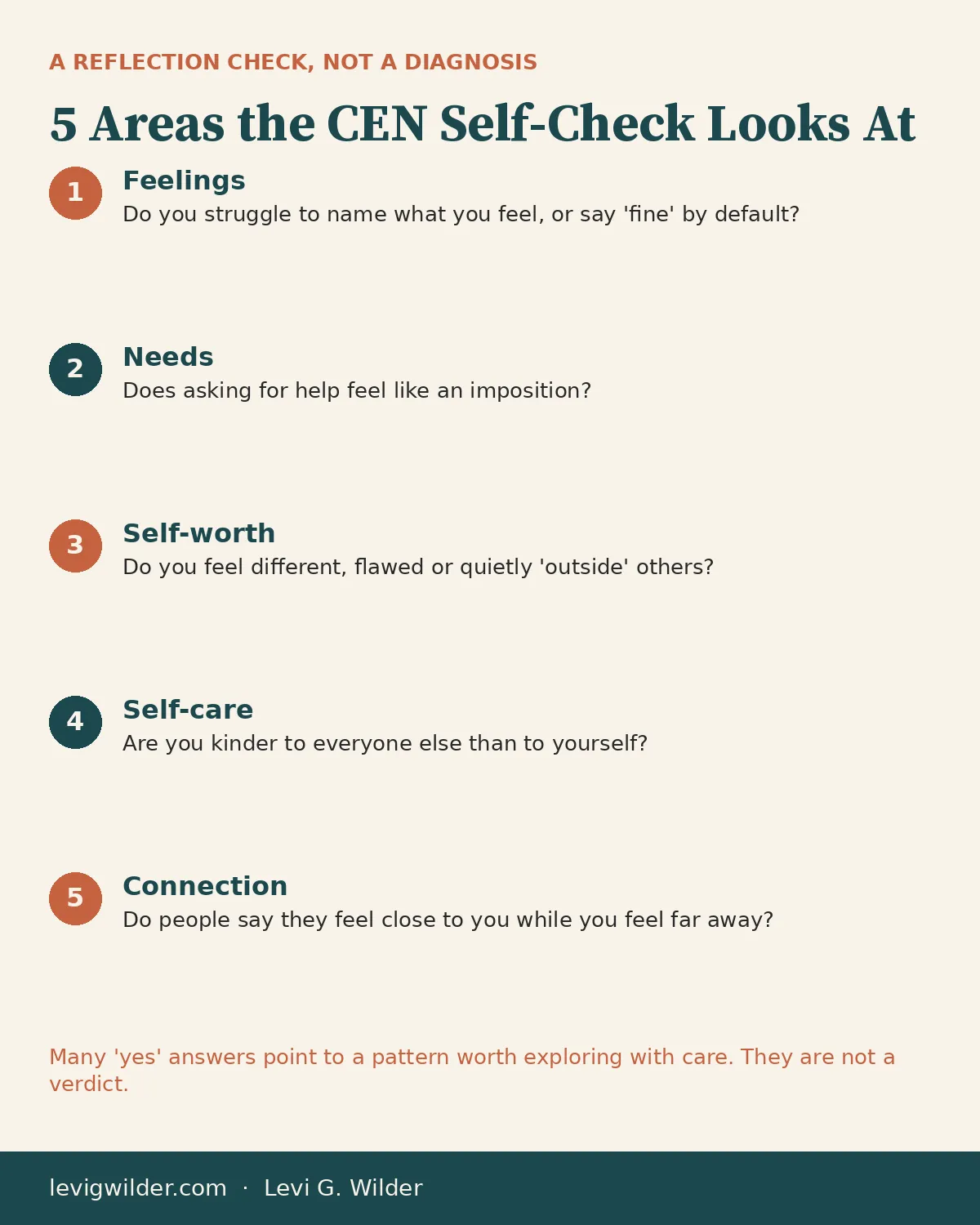
If you'd like a more structured way to reflect, try the childhood emotional neglect self-check.
How does it show up in adult life?
Children adapt to what they have. The adaptations that kept you safe at home can feel like problems later. Common patterns include:
- Trouble naming feelings. A meta-analysis found that child maltreatment, including emotional neglect, is linked with alexithymia, which means difficulty identifying and describing emotions (Ditzer et al., 2023).
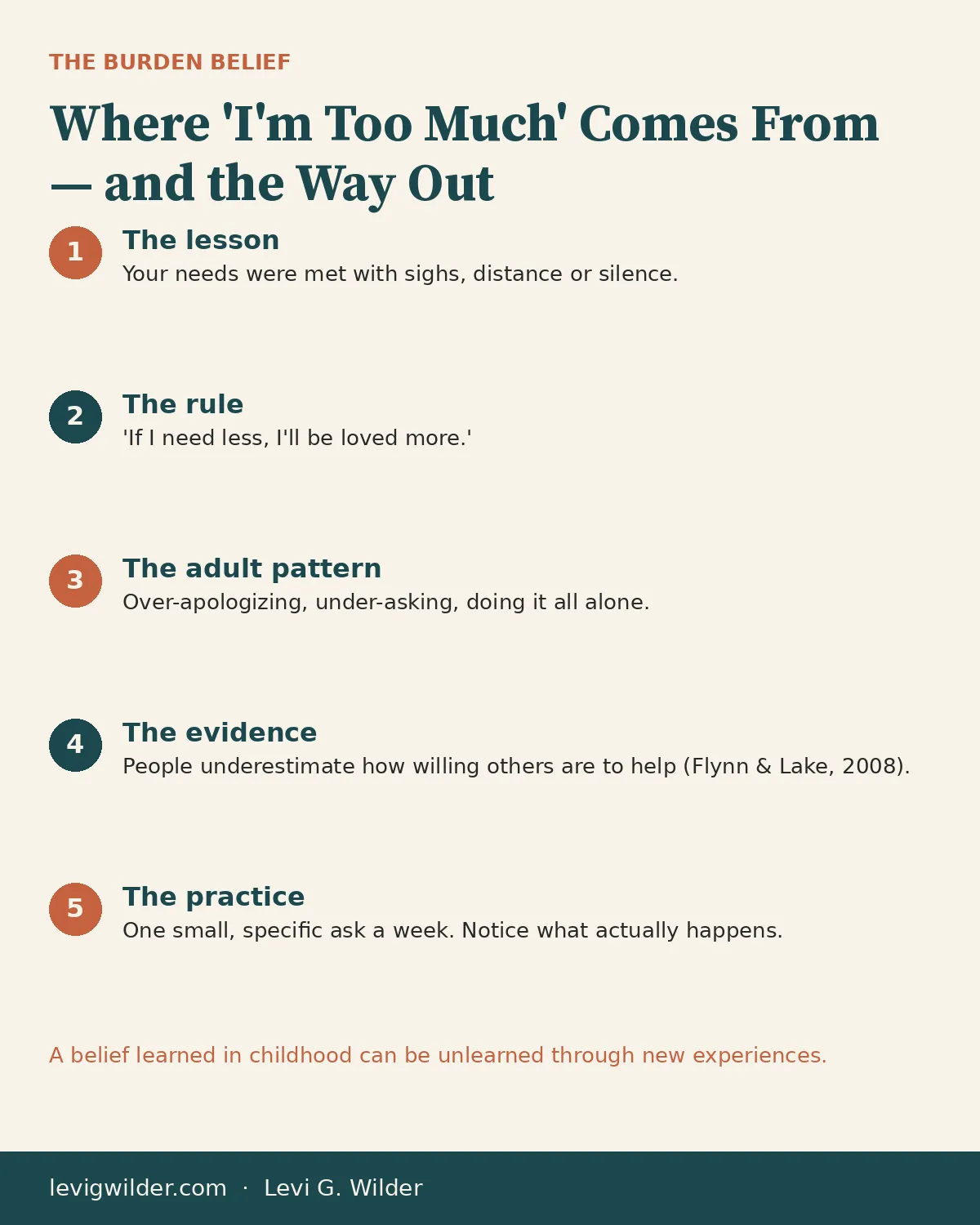
- Feeling like a burden. If needs once seemed to strain your parents, asking for anything can still feel like an imposition. See why do I feel like a burden?
- Hyper-independence. Doing everything yourself because relying on others never felt safe.
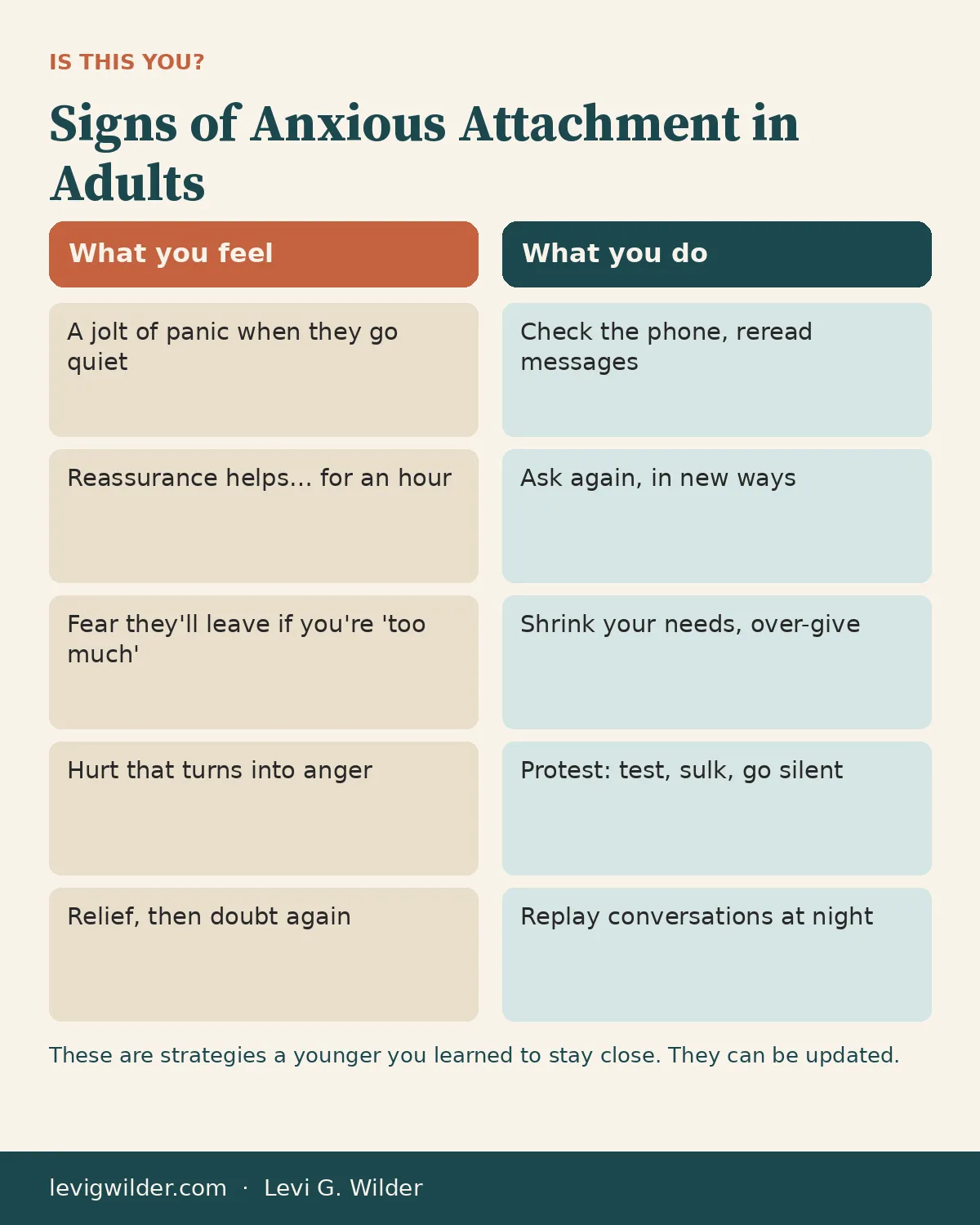
- Anxious or avoidant patterns in love. Some people cling and seek reassurance; others keep partners at arm's length. The signs of anxious attachment in adults describes one common version.
- A harsh inner critic and difficulty treating yourself kindly.
- A vague sense of emptiness or of being different from other people, even when life looks fine from the outside.
Emotional neglect is common. A meta-analysis of studies worldwide found that self-reported emotional neglect was one of the most frequently reported forms of child maltreatment (Stoltenborgh, Bakermans-Kranenburg & van IJzendoorn, 2013). A large review linked emotional abuse and neglect with later depression, anxiety and other health problems (Norman et al., 2012). Those are associations across large groups, not a prediction about you. Many people with these histories live full, connected lives, often after learning the skills they missed.
Were your parents bad people?
Usually not. Emotional neglect is often passed down: parents can't give what they never received. Glaser's framework stresses that psychological maltreatment doesn't require any intent to harm (Glaser, 2002).
Both things can be true at once. Your parents may have loved you and done their best. And you may still have missed something important. Naming the second doesn't erase the first. It just lets you stop blaming yourself for struggling.
How can you start to heal?
You can't go back and get the childhood you needed. But you can learn the skills it would have taught you. Here are four places to start.
- Name one feeling a day. Pause once a day and ask, "What am I feeling right now?" Even "tired" or "tense" counts. Putting feelings into words helps regulate them (Lieberman et al., 2007).
- Treat yourself the way you'd treat a child you love. When you notice self-criticism, try one sentence of kindness instead. Self-compassion interventions have been shown to reduce self-criticism, depression and anxiety (Ferrari et al., 2019).
- Make one small request. Ask a safe person for something low-stakes. People tend to underestimate how willing others are to help (Flynn & Lake, 2008).
- Decide what you want from your parents now. Some people want an honest conversation; others want distance; others want to keep things as they are and heal on their own. All are valid.
If the effects feel heavy, or if you're dealing with depression or trauma, working with a therapist can help a great deal.
Where can you go from here?
I wrote The Emotional Neglect Workbook for adults who grew up with their physical needs met but their feelings unseen. It walks you step by step through naming emotions, asking for help without guilt and quieting the inner critic. It's available as an ebook on Google Play Books or as a printable PDF. If you also struggle with anxiety in relationships, the bundle includes Loved but Never Seen, my anxious attachment workbook. See everything on the books page.
FAQ
What are emotionally unavailable parents?
They are parents who provided physical care but rarely noticed, named or responded to their child's feelings. It is often unintentional and is one of the main forms of childhood emotional neglect.
How do I know if my parents were emotionally unavailable?
Common signs include feelings being ignored or dismissed, little comfort when you were upset, few conversations about emotions, and feeling more valued for being easy or accomplished than for who you were.
How does having emotionally unavailable parents affect adults?
Adults often find it hard to name feelings, ask for help, trust closeness or treat themselves kindly. Research links childhood emotional neglect with alexithymia and with later mental health difficulties.
Can emotionally unavailable parents still love their children?
Yes. Many emotionally unavailable parents loved their children deeply. They may have been overwhelmed, unwell, or raised without emotional language themselves.
How do you heal from emotionally unavailable parents?
Start by learning to notice and name your feelings, practising self-compassion, and making small requests for support from safe people. Therapy can help, especially if the effects are heavy.
Sources
- Ditzer, J., et al. (2023). Child maltreatment and alexithymia: A meta-analytic review. Psychological Bulletin, 149, 311–329. https://doi.org/10.1037/bul0000391
- Eisenberg, N., Cumberland, A., & Spinrad, T. L. (1998). Parental socialization of emotion. Psychological Inquiry, 9, 241–273. https://doi.org/10.1207/s15327965pli0904_1
- Ferrari, M., et al. (2019). Self-compassion interventions and psychosocial outcomes: A meta-analysis of RCTs. Mindfulness, 10, 1455–1473. https://doi.org/10.1007/s12671-019-01134-6
- Flynn, F. J., & Lake, V. K. B. (2008). If you need help, just ask: Underestimating compliance with direct requests for help. Journal of Personality and Social Psychology, 95, 128–143. https://doi.org/10.1037/0022-3514.95.1.128
- Glaser, D. (2002). Emotional abuse and neglect (psychological maltreatment): A conceptual framework. Child Abuse & Neglect, 26, 697–714. https://doi.org/10.1016/S0145-2134(02)00342-3
- Gottman, J. M., Katz, L. F., & Hooven, C. (1996). Parental meta-emotion philosophy and the emotional life of families. Journal of Family Psychology, 10, 243–268. https://doi.org/10.1037/0893-3200.10.3.243
- Lieberman, M. D., et al. (2007). Putting feelings into words. Psychological Science, 18, 421–428. https://doi.org/10.1111/j.1467-9280.2007.01916.x
- Norman, R. E., et al. (2012). The long-term health consequences of child physical abuse, emotional abuse, and neglect: A systematic review and meta-analysis. PLoS Medicine, 9, e1001349. https://doi.org/10.1371/journal.pmed.1001349
- Stoltenborgh, M., Bakermans-Kranenburg, M. J., & van IJzendoorn, M. H. (2013). The neglect of child neglect: A meta-analytic review of the prevalence of neglect. Social Psychiatry and Psychiatric Epidemiology, 48, 345–355. https://doi.org/10.1007/s00127-012-0549-y