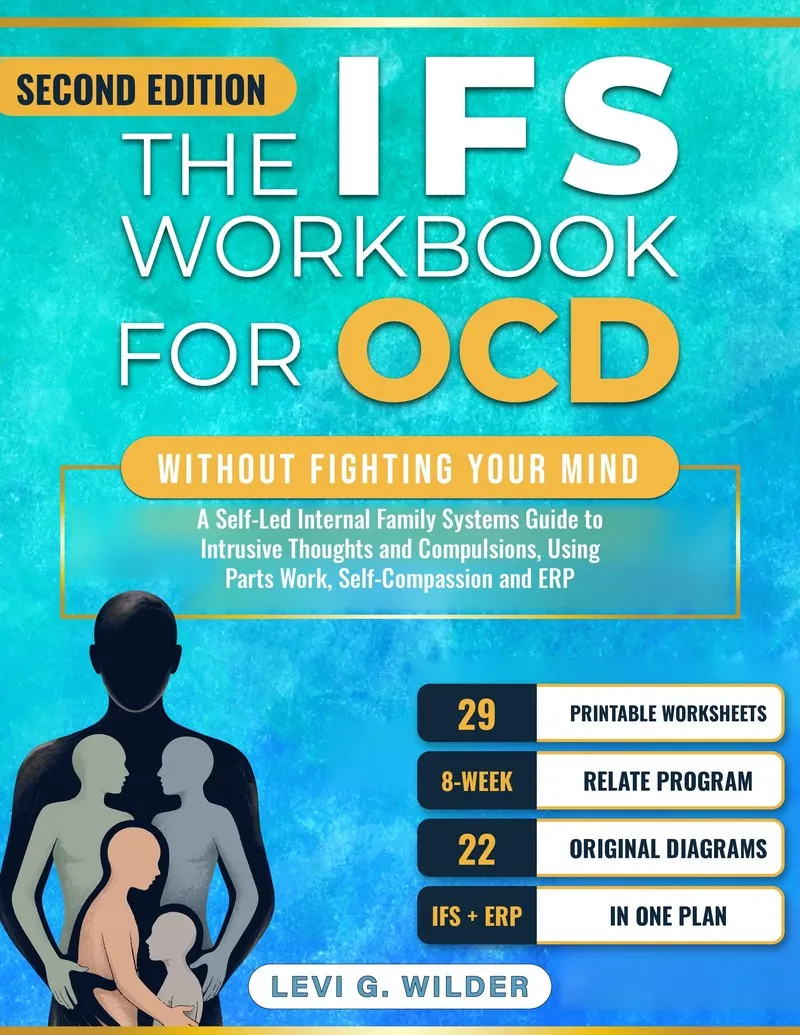
Second Edition (2026) · Workbook · by Levi G. Wilder
The IFS Workbook for OCD
A Self-Led Internal Family Systems Guide to Intrusive Thoughts and Compulsions, Using Parts Work, Self-Compassion and ERP
Free companionFree IFS–OCD companionPrintable PDF resources for readers. Free download.Pairs exposure and response prevention (ERP), the first-line psychological treatment for OCD, with Internal Family Systems parts work and self-compassion. Second edition, revised for 2026.
About this book
An intrusive thought you never asked for. A spike of fear. The urge to check, wash, confess, review or ask for reassurance, and the relief that never lasts. What if the part of you that won’t let it go is trying to keep you safe?
This second edition pairs exposure and response prevention (ERP), the first-line psychological treatment for OCD, with Internal Family Systems (IFS) parts work and self-compassion. You learn to meet the frightened, hard-working parts behind obsessions and compulsions from a calmer, more curious place IFS calls Self, and to use that steadiness to take the ERP steps that actually loosen OCD’s grip.
This book is independent and isn’t endorsed by the IFS Institute. It’s a self-help guide, not IFS therapy, and it is meant to sit alongside ERP and professional care, not replace them.
Inside the workbook
- The RELATE protocol from the first edition (Recognize, Engage, Listen, Acknowledge, Trust, Empower), now as a step-by-step program with an ERP step built into every week
- Chapters for contamination, harm thoughts, taboo thoughts, relationship OCD, scrupulosity, checking and “just right” OCD, and Pure-O
- A full chapter on stopping parts work from turning into one more compulsion
- Guided practices in a warm, conversational voice, with every example clearly labelled as an illustration
- 22 original diagrams and honest 2026 research notes on what is and isn’t proven
- Help for families, setbacks, medication and finding a therapist
- Reflection questions in every chapter, plus a printable companion with all 29 worksheets
Who it's for
This book is for adults with obsessive-compulsive disorder (OCD) or intrusive thoughts who want a trauma-informed, self-led approach, and for readers who already know IFS and want to apply parts work to OCD.
Frequently asked questions
Can IFS help with OCD?
IFS offers a different way to relate to intrusive thoughts and compulsions: as protective parts you can get to know with curiosity, rather than enemies to fight. Research on IFS for OCD specifically is still early, so this book presents it as a complement to evidence-based care, not a proven stand-alone treatment.
Is this book a replacement for ERP or therapy?
No. Exposure and response prevention (ERP) remains the best-researched first treatment for OCD. The workbook is meant to sit alongside ERP and care from a qualified clinician, not replace them.
What is a “part” in IFS, and how does it relate to intrusive thoughts?
In IFS, a part is a sub-personality with its own feelings and intentions. The book treats obsessions and compulsions as the work of protective parts trying to keep you safe, and shows you how to meet them from Self, the calmer, more curious core that IFS describes.
Which types of OCD does the book cover?
It has chapters for contamination, harm thoughts, taboo thoughts, relationship OCD, scrupulosity, checking and “just right” OCD, and Pure-O.
What is the RELATE protocol?
RELATE stands for Recognize, Engage, Listen, Acknowledge, Trust and Empower. In the second edition it runs as a step-by-step program with an ERP step built into every week.
Is the author a therapist?
No. Levi G. Wilder is a researcher and trauma survivor, not a therapist. The book is for education and self-help.
What formats can I buy?
The ebook is $9.99 on Google Play Books. On Gumroad, $9.99 gets you the EPUB and PDF plus the printable companion with all 29 worksheets.
Related reading
Read first
Start with the free guide on this topic →
About the author
Levi G. Wilder is a researcher and trauma survivor who writes research-based self-help workbooks. He isn't a therapist. This book is for education and self-help and doesn't replace professional care.