IFS Self-Therapy: How to Start Internal Family Systems Parts Work on Your Own, Safely
Internal Family SystemsInner CriticTrauma Recovery
Quick answer
Can you do IFS therapy on yourself?
IFS self-therapy means using Internal Family Systems ideas on your own: noticing your 'parts' (like an inner critic or a people-pleaser), getting curious about what each one is trying to protect, and relating to them from a calmer state IFS calls Self. You can safely start with protector parts and short sessions. Deep work with painful 'exile' parts, especially after trauma, is best done slowly and ideally with a trained therapist. Research on IFS is promising but still early.
By Levi G. Wilder. I'm a researcher and trauma survivor, not a therapist. This article is education, not therapy. If you live with trauma, dissociation, or thoughts of harming yourself, please work with a qualified professional. In a crisis, contact your local emergency number or a crisis line.
Most of us know the feeling of being "of two minds". Part of you wants to rest; another part says you haven't earned it. Part of you wants to speak up; another part keeps the peace at any cost. Internal Family Systems, or IFS, takes that everyday experience seriously. It says the mind is naturally made of parts, and that even the harshest ones are trying to help.
This guide explains what IFS is, how you can begin practising it on your own in a safe, gentle way, what the research does and doesn't show, and where self-help should stop.
What is Internal Family Systems?
IFS is a model of psychotherapy developed by Richard Schwartz from the 1980s onwards (Schwartz & Sweezy, 2020). It sees the mind as a system of sub-personalities, or parts, each with its own feelings, beliefs and goals. IFS assumes there are no bad parts, only parts stuck in extreme roles, often because of painful past experiences (Schwartz, 2021).
IFS also describes a core Self: a calm, curious, compassionate presence that everyone has, even when it's hidden under strong parts. The aim isn't to get rid of parts. It's to help them trust Self to lead.
The three kinds of parts
- Managers try to keep you safe by staying in control: the inner critic, the perfectionist, the planner, the people-pleaser.
- Firefighters act fast to put out emotional pain once it breaks through: bingeing, numbing out, scrolling for hours, sudden rage.
- Exiles carry old hurt, fear or shame, often from childhood. Protectors work hard to keep them out of awareness.
Managers and firefighters are both protectors. That framing matters. A critic that says "you're lazy" may be trying, in a clumsy way, to stop you from being rejected or failing again.
How to start IFS on your own: the six Fs
IFS gives a simple sequence for getting to know a protector part, often called the six Fs (Schwartz & Sweezy, 2020). Start with a mild part, like a worrying or planning part, not your most painful material.
- Find the part. Notice a thought, feeling, urge or body sensation. Where is it?
- Focus on it. Turn your attention toward it with interest rather than pushing it away.
- Flesh it out. What does it look, sound or feel like? Does it have an age, an image, a tone of voice?
- Feel toward. Ask yourself: how do I feel toward this part? If the answer is annoyed, afraid or ashamed, that's another part. Ask it, kindly, to step back a little. When you feel curious or open, Self is more present.
- Befriend it. Ask what it wants you to know, and what job it does for you. Thank it for trying to help.
- Fears. Ask: what are you afraid would happen if you stopped doing this job? The answer often points to what it's protecting.
Ten or fifteen minutes is plenty. You can write the answers down, speak them aloud, or simply notice. Finish by thanking your parts and grounding yourself: feel your feet on the floor and look around the room.
A worked example: the inner critic
Say a critic part tells you you're useless after a small mistake. Instead of arguing with it or believing it, you might notice it as tightness in your chest and a sharp voice. You get curious and ask what it's trying to do. It may say it wants to stop you from being embarrassed again. When you ask what it fears, it may point to an old sense of not being good enough.
You don't need to dig into that old pain today. Just acknowledging the critic's intention often softens it. Research outside IFS supports a similar direction: people who respond to their mistakes with self-compassion tend to stay as motivated, and often more motivated, to improve (Breines & Chen, 2012).
Safety first: where self-help should slow down
IFS can bring up strong emotions, especially when protectors start to step back and exiles come closer. For trauma survivors, careful pacing is essential. Expert guidance on complex trauma recommends building safety and emotional regulation skills before working directly with traumatic memories (Cloitre et al., 2011).
Slow down or stop if you feel flooded, numb, spacey, or panicky, or if you lose track of time. Good self-help rules:
- Work with protectors first. Ask their permission before going near anything painful.
- Keep sessions short, and end with grounding.
- Don't try to "unburden" exiles on your own if you have significant trauma.
- If you experience dissociation, memory gaps or feel like separate people, work with a trauma-trained clinician. Specialist guidelines exist for this for good reason (International Society for the Study of Trauma and Dissociation, 2011).
What the research shows
- Rheumatoid arthritis. In a randomized controlled trial with 79 adults, an IFS-based group program improved some measures, including pain, depressive symptoms and self-compassion, compared with education by mail. The authors called it a proof-of-concept study, and not every gain lasted at follow-up (Shadick et al., 2013).
- Depression. In a small pilot trial with female college students, both IFS and the comparison treatment reduced depression, and IFS performed similarly (Haddock et al., 2017).
- PTSD. In a small pilot study of adults with PTSD after multiple childhood traumas, symptoms fell after sixteen sessions of IFS therapy. There was no control group, so it can't show that IFS caused the change (Hodgdon et al., 2022).
Some of IFS's ingredients have wider support. Putting feelings into words can reduce their intensity (Lieberman et al., 2007), and compassion-based interventions show moderate benefits across many studies (Kirby et al., 2017). Overall, IFS is promising but not yet backed by large trials. For PTSD, guidelines recommend trauma-focused therapies with stronger evidence (National Institute for Health and Care Excellence, 2018). IFS ideas can sit alongside those, not replace them.
The new second edition of The IFS Self-Therapy Workbook expands this into a 10-week practice (coming soon). If intrusive thoughts are part of your picture, read how IFS can help with OCD and see The IFS Workbook for OCD.
Go deeper
I wrote a gentle, step-by-step guide to this practice: The IFS Self-Therapy Workbook, Second Edition. It has a 10-week core practice built on the six Fs, chapters on the inner critic, the inner child, people-pleasing and shame, and safety rules for trauma survivors. The new edition is coming soon to Google Play and major ebook stores. The printable IFS Self-Therapy Toolkit is available on Gumroad now.
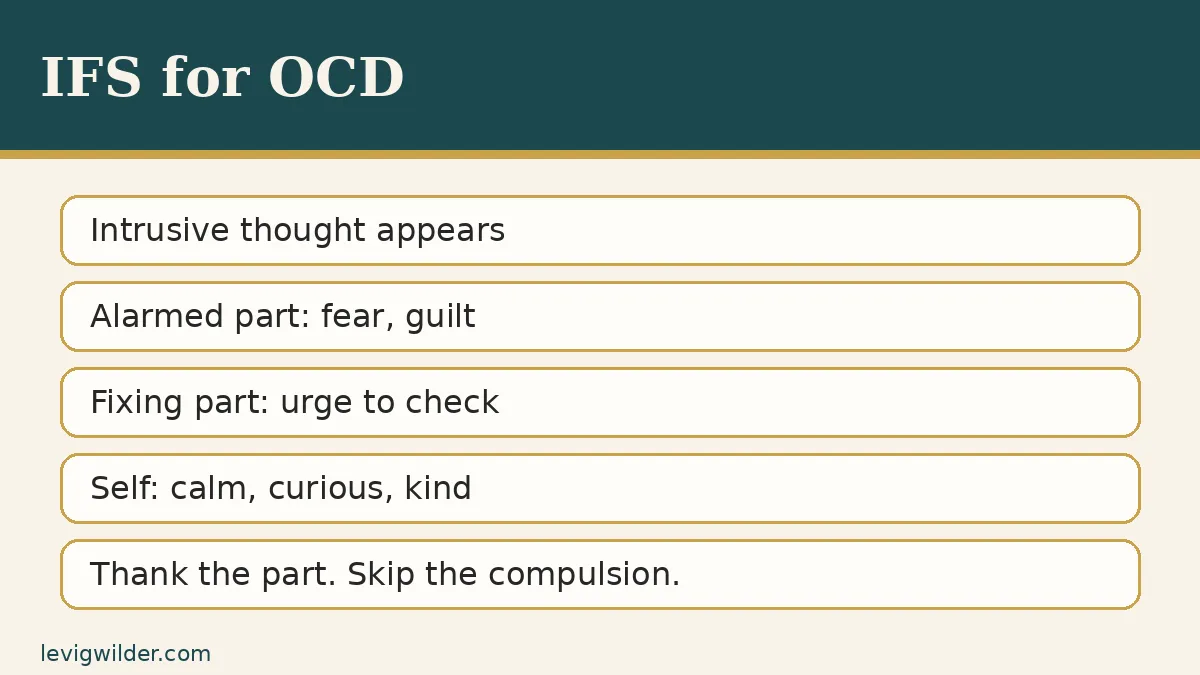
If OCD is part of your picture, read IFS for OCD. If your inner critic took shape in a childhood where your feelings went unseen, emotional neglect vs emotional abuse may help.
This article and the book are independent and aren't endorsed by the IFS Institute.
Sources
- Breines, J. G., & Chen, S. (2012). Self-compassion increases self-improvement motivation. Personality and Social Psychology Bulletin, 38(9), 1133–1143. https://doi.org/10.1177/0146167212445599
- Cloitre, M., Courtois, C. A., Charuvastra, A., Carapezza, R., Stolbach, B. C., & Green, B. L. (2011). Treatment of complex PTSD: Results of the ISTSS expert clinician survey on best practices. Journal of Traumatic Stress, 24(6), 615–627. https://doi.org/10.1002/jts.20697
- Haddock, S. A., Weiler, L. M., Trump, L. J., & Henry, K. L. (2017). The efficacy of Internal Family Systems therapy in the treatment of depression among female college students: A pilot study. Journal of Marital and Family Therapy, 43(1), 131–144. https://doi.org/10.1111/jmft.12184
- Hodgdon, H. B., Anderson, F. G., Southwell, E., Hrubec, W., & Schwartz, R. (2022). Internal Family Systems (IFS) therapy for posttraumatic stress disorder (PTSD) among survivors of multiple childhood trauma: A pilot effectiveness study. Journal of Aggression, Maltreatment & Trauma, 31(1), 22–43. https://doi.org/10.1080/10926771.2021.2013375
- International Society for the Study of Trauma and Dissociation. (2011). Guidelines for treating dissociative identity disorder in adults, third revision. Journal of Trauma & Dissociation, 12(2), 115–187. https://doi.org/10.1080/15299732.2011.537247
- Kirby, J. N., Tellegen, C. L., & Steindl, S. R. (2017). A meta-analysis of compassion-based interventions: Current state of knowledge and future directions. Behavior Therapy, 48(6), 778–792. https://doi.org/10.1016/j.beth.2017.06.003
- Lieberman, M. D., Eisenberger, N. I., Crockett, M. J., Tom, S. M., Pfeifer, J. H., & Way, B. M. (2007). Putting feelings into words: Affect labeling disrupts amygdala activity in response to affective stimuli. Psychological Science, 18(5), 421–428. https://doi.org/10.1111/j.1467-9280.2007.01916.x
- National Institute for Health and Care Excellence. (2018). Post-traumatic stress disorder (NICE guideline NG116). https://www.nice.org.uk/guidance/ng116
- Schwartz, R. C. (2021). No bad parts: Healing trauma and restoring wholeness with the Internal Family Systems model. Sounds True.
- Schwartz, R. C., & Sweezy, M. (2020). Internal family systems therapy (2nd ed.). Guilford Press.
- Shadick, N. A., Sowell, N. F., Frits, M. L., et al. (2013). A randomized controlled trial of an internal family systems-based psychotherapeutic intervention on outcomes in rheumatoid arthritis: A proof-of-concept study. The Journal of Rheumatology, 40(11), 1831–1841. https://doi.org/10.3899/jrheum.121465