What Is Inference-Based CBT (I-CBT) for OCD? How It Works and What the Research Shows
Quick answer
What is Inference-Based CBT (I-CBT) for OCD?
Inference-Based CBT (I-CBT) is a psychological treatment for OCD that targets the doubt at the start of the obsessional loop. It teaches you to notice when a doubt comes from an imagined story rather than from your senses, and to return to what is actually in front of you. In a 2022 randomized trial with 111 adults, I-CBT reduced OCD severity about as much as standard CBT. ERP remains the best-studied first-line treatment; I-CBT is a credible option alongside it.
By Levi G. Wilder. I'm a researcher and trauma survivor, not a therapist. This article is education, not diagnosis or treatment. If OCD is taking hours of your day, please talk to a clinician trained in OCD.
You locked the door. You saw it lock. And still the thought arrives: but did I really? Most OCD help focuses on what happens after that thought: the anxiety, the urge to check, the relief that never lasts. Inference-Based Cognitive Behavioral Therapy, or I-CBT, starts one step earlier. It looks at the doubt itself, and at how OCD convinces you to trust an imagined story over what your own senses just told you.
This guide explains what I-CBT is, the core ideas in plain language, how it differs from exposure and response prevention (ERP), and what the published trials do and don't show.
What is I-CBT?
I-CBT is a psychological treatment for obsessive-compulsive disorder (OCD). It grew out of clinical research in Montreal from the 1990s onwards, led by Kieron O'Connor and later Frederick Aardema and colleagues (O'Connor & Aardema, 2012). They noticed that many people with OCD seemed stuck less on the feared consequence than on the doubt that came first: maybe the stove is on, maybe I'm a bad person, maybe I don't really love my partner.
The model says the obsessional doubt isn't random. It is the end point of a chain of reasoning that feels logical from the inside but steps away from reality at a specific moment. Change how you reason at that moment, the idea goes, and the doubt loses its grip, so the anxiety and compulsions that follow have less to feed on (Julien et al., 2016).
The core idea: inferential confusion
I-CBT calls the central problem inferential confusion. It means treating an imagined possibility as if it were evidence about what's real, while distrusting what your senses and common sense tell you (Aardema et al., 2005).
Here's how that looks in everyday OCD:
- Checking: you see the door is locked, but "I might have been distracted" outweighs what you saw.
- Contamination: your hands look and feel clean, but "there could be invisible germs" feels more real than your eyes.
- Harm thoughts: nothing in your history suggests you'd hurt anyone, but "people snap without warning" becomes the deciding argument.
- Relationship OCD: you feel affection for your partner, but "what if I'm only telling myself that?" overrides it.
In each case the doubt doesn't come from the here and now. It comes from stories, facts out of context, and "what ifs" that could apply to anyone at any time. I-CBT teaches you to notice that shift and step back onto what is actually in front of you.
The obsessional story and the feared self
I-CBT treats each obsession as a story: a convincing sequence of ideas, facts and possibilities that leads to the doubt. Part of the work is writing that story out, spotting the reasoning moves that make it persuasive, and then writing an alternative story that is grounded in your senses and ordinary common sense.
The approach also describes a feared self: the person you're afraid you might secretly be, such as careless, dangerous or immoral. Research in this tradition developed a questionnaire to measure fear of self and found it linked to obsessional symptoms (Aardema et al., 2013). Recognising that the feared self is built from "maybe" rather than from who you've actually been is often a turning point.
How I-CBT differs from ERP
ERP is the best-studied psychological treatment for OCD and is recommended as a first-line option in clinical guidelines (National Institute for Health and Care Excellence, 2005). ERP mainly works at the anxiety and compulsion end of the cycle: you face triggers and resist compulsions until the anxiety settles and you learn you can tolerate uncertainty.
I-CBT mainly works at the doubt end. It doesn't ask you to argue with your thoughts or prove them false, and it doesn't rely on planned exposure exercises. Instead it helps you see that the doubt was never based on anything real in the first place, so there is nothing to resolve.
The two approaches aren't enemies. Some people find I-CBT ideas make ERP easier to understand: "I'm leaving the door after one check because the doubt isn't based on anything real," not only "because I'm practising tolerating anxiety."
One important caution: I-CBT is not permission to avoid what you fear. If you stay away from knives, public toilets or your partner's phone, the doubt keeps its power. In I-CBT, avoidance counts as a compulsion too.
What the research shows
- The largest trial (2022). A multicentre randomized controlled trial with 111 adults with OCD compared I-CBT, appraisal-based CBT and a mindfulness-based program. I-CBT and appraisal-based CBT reduced OCD severity with no significant difference between them. I-CBT also led to greater improvement in strongly held, overvalued ideas than the mindfulness comparison (Aardema et al., 2022).
- Poor insight (2015). In a trial of 90 people whose obsessional fears felt highly believable, both I-CBT and CBT reduced symptoms, with no overall difference. In a small subgroup with the poorest insight, people receiving the inference-based approach improved more (Visser et al., 2015).
- Early evaluation (2005). The first controlled evaluation found the inference-based approach reduced symptoms, especially in people with high conviction in their obsessions (O'Connor et al., 2005).
Put honestly: I-CBT is newer than ERP and has less research behind it. The trials so far suggest it is a legitimate option that works about as well as standard CBT, and it may be especially worth considering when your doubts feel very convincing, when your compulsions are mostly mental, or when the idea of exposure stops you seeking help at all.
Is I-CBT right for you?
Some honest pointers:
- Stay with ERP if it's working, even slowly. Switching approach because a session felt hard is often OCD looking for a way out.
- Consider I-CBT if you've tried ERP properly and it didn't help, your obsessions feel very believable, or your compulsions are mostly mental reviewing and reassurance.
- Consider both if you're in ERP and want to understand the doubt better.
Whatever you choose, get professional help if OCD takes up a lot of your day, affects your work, studies or relationships, or comes with thoughts of harming yourself.
A small first step you can try today
Next time a doubt shows up, pause and ask one question: "Is this doubt coming from something I can see, hear or touch right now, or from a story about what might be?" You don't need to answer the doubt. Just notice where it comes from. If it comes from a story, the I-CBT move is to come back to your senses and carry on with what you were doing, without one more check.
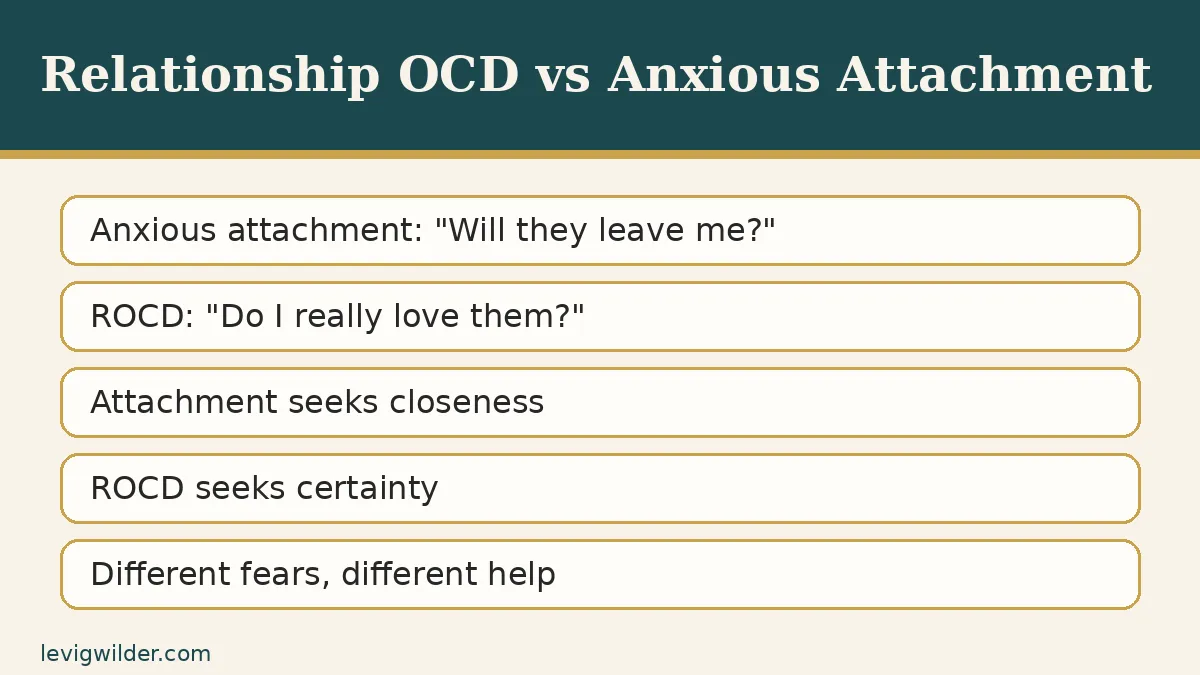
The new second edition of The I-CBT Workbook for OCD turns this into a 12-week program (coming soon). Some readers also find it helps to use IFS parts work alongside OCD treatment, and if relationship doubts are your main theme, see ROCD vs anxious attachment.
Go deeper
I turned the published I-CBT program into a structured 12-week workbook: The I-CBT Workbook for OCD, Second Edition. It covers inferential confusion, the reasoning devices, the obsessional story, trusting your senses and the feared self, with theme chapters on checking, contamination, harm thoughts, ROCD, scrupulosity and Pure O. The new edition is coming soon to Google Play and major ebook stores. Meanwhile, the I-CBT bonus pack and 50 journal prompts for OCD are a free download (PDF).
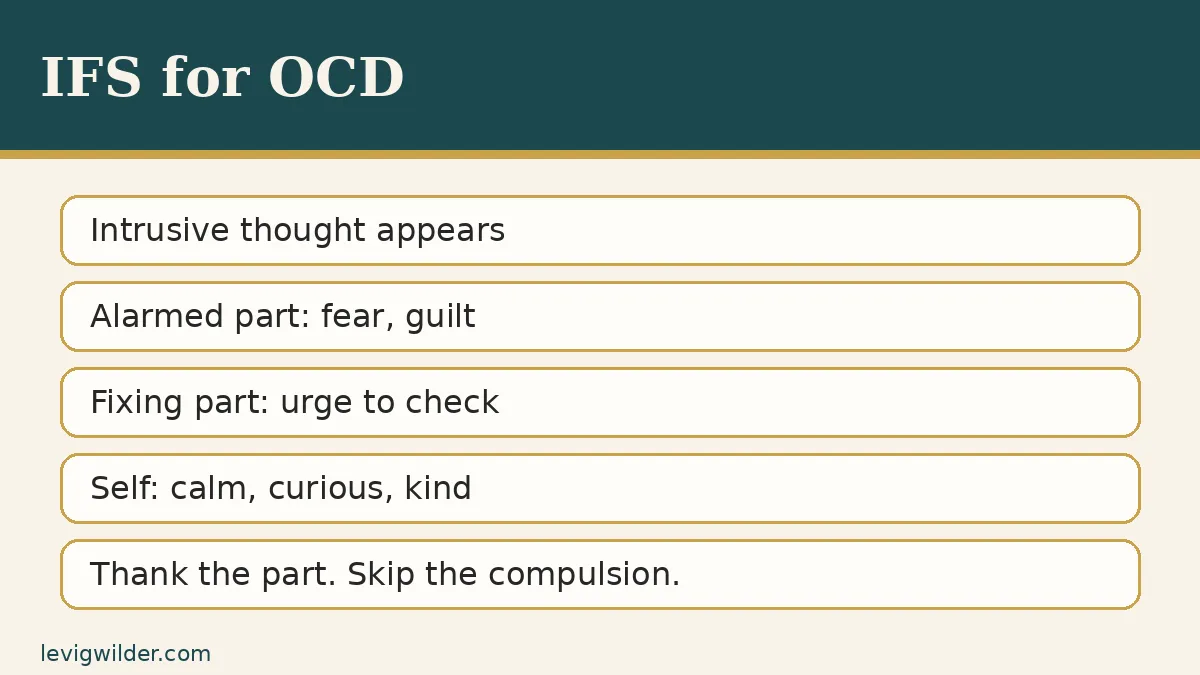
If your intrusive thoughts are about your relationship, read Relationship OCD vs anxious attachment. If you're curious about a gentler, parts-based angle, see IFS for OCD.
Sources
- Aardema, F., Bouchard, S., Koszycki, D., Lavoie, M. E., Audet, J.-S., & O'Connor, K. (2022). Evaluation of inference-based cognitive-behavioral therapy for obsessive-compulsive disorder: A multicenter randomized controlled trial with three treatment modalities. Psychotherapy and Psychosomatics, 91(5), 348–359. https://doi.org/10.1159/000524425
- Aardema, F., Moulding, R., Radomsky, A. S., Doron, G., Allamby, J., & Souki, E. (2013). Fear of self and obsessionality: Development and validation of the Fear of Self Questionnaire. Journal of Obsessive-Compulsive and Related Disorders, 2(3), 306–315. https://doi.org/10.1016/j.jocrd.2013.05.005
- Aardema, F., O'Connor, K. P., Emmelkamp, P. M. G., Marchand, A., & Todorov, C. (2005). Inferential confusion in obsessive-compulsive disorder: The inferential confusion questionnaire. Behaviour Research and Therapy, 43(3), 293–308. https://doi.org/10.1016/j.brat.2004.02.003
- Julien, D., O'Connor, K., & Aardema, F. (2016). The inference-based approach to obsessive-compulsive disorder: A comprehensive review of its etiological model, treatment efficacy, and model of change. Journal of Affective Disorders, 202, 187–196. https://doi.org/10.1016/j.jad.2016.05.060
- National Institute for Health and Care Excellence. (2005). Obsessive-compulsive disorder and body dysmorphic disorder: Treatment (Clinical guideline CG31). https://www.nice.org.uk/guidance/cg31
- O'Connor, K., & Aardema, F. (2012). Clinician's handbook for obsessive compulsive disorder: Inference-based therapy. Wiley-Blackwell. https://doi.org/10.1002/9781119960027
- O'Connor, K., Aardema, F., Bouthillier, D., Fournier, S., Guay, S., Robillard, S., Pélissier, M.-C., Landry, P., Todorov, C., Tremblay, M., & Pitre, D. (2005). Evaluation of an inference-based approach to treating obsessive-compulsive disorder. Cognitive Behaviour Therapy, 34(3), 148–163. https://doi.org/10.1080/16506070510041211
- Visser, H. A., van Megen, H., van Oppen, P., Eikelenboom, M., Hoogendorn, A. W., Kaarsemaker, M., & van Balkom, A. J. (2015). Inference-based approach versus cognitive behavioral therapy in the treatment of obsessive-compulsive disorder with poor insight: A 24-session randomized controlled trial. Psychotherapy and Psychosomatics, 84(5), 284–293. https://doi.org/10.1159/000382131